• Offer for Industry
  • Young GI
  • Patients
  • Press
  • Newsletter
  • Contact us
UEG Connect
Create myUEG account
  • About
    • To landing page
      • Who we are
      • Boards, Committees & Groups
      • Governance
      • Headquarters Management
      • History
      • What we do
      • Strategic Drivers
      • Year in Review
      • Our Members
      • Specialist Member Societies
      • National Member Societies
      • UEG Community
      • UEG Associates
      • UEG Connect
      • Women in GI
      • Young GIs
      • Researchers
      • Event Calendar
  • Week
    • To landing page
      • Attendance
      • Programme
      • Abstract Submission
      • Postgraduate Teaching
      • Industry
      • Supporters
      • Congress Resources
      • UEG Week Recordings ↗
      • CME Accreditation
      • Future UEG Week
  • Education
    • To landing page
      • Gutflix - Learning Platform ↗
      • Online Courses ↗
      • Mistakes in... ↗
      • UEG Podcast ↗
      • Webinars ↗
      • Summer School
      • Masterclass
      • Gut Guide
      • Career Development
      • CME in Europe
      • Supporters
  • Research
    • To landing page
      • Horizon Europe Support
      • Start-up Grant
      • Research Projects
      • HoloSurge
      • Intercept
      • InfoGut COST Action
      • White Book 2
      • Main Results
      • Full Reports
      • Materials and Presentations
  • Quality of Care
    • To landing page
      • Search Guidelines ↗
      • Non-English Guidelines
      • How to Develop Guidelines ↗
      • Quality of Care Initiatives
      • Quality Indicators
  • Public Affairs
    • To landing page
      • News
      • Focus Areas
      • Advocacy Toolbox
      • Stakeholder Collaboration
      • Digestive Health Month
      • Position Papers
      • Advocacy Bulletin
      • #EUNewsline
      • MEP Digestive Health Group
  • Publications
    • To landing page
      • Congress Publications
      • Research Publications
      • Public Affairs Publications
      • Education Publications
      • UEG Publications
      • UEG Journal ↗
      • UEG Journal Podcast ↗
  • Opportunities
    • To landing page
      • Top Abstract Prizes
      • National Scholar Award
      • Travel Grants
      • International Scholarship Awards
      • Research Prize
      • Research Fellowship
      • Lifetime Achievement Award
      • Journal Best Paper Award
      • Activities Endorsement
      • Rising Star Awards
      • Clinical Visiting Fellowships
      • Open Positions
      • Talent Pool
  • Gutflix ↗
  • Offer for Industry
  • Young GI
  • Patients
  • Press
  • Newsletter
  • Contact us
Decide on the Spot

A thorny problem

May 10, 2016 | Ruchit Sood

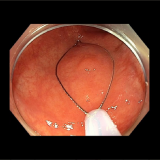
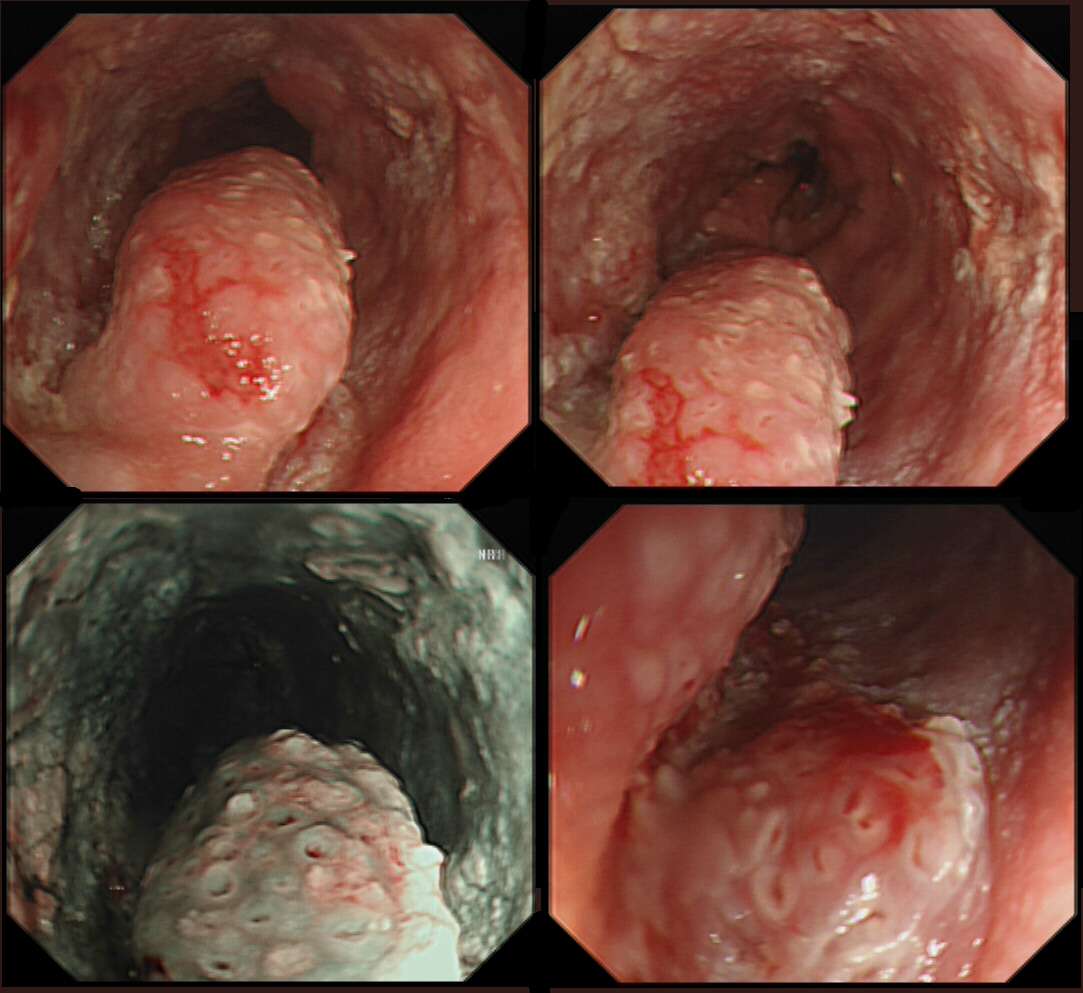
A patient attended for a gastroscopy because of some pain on swallowing. At endoscopy, the nodule shown in the photograph was found in the mid oesophagus. A photograph of the patient's feet is also shown.

Case question 1

What is the most likely diagnosis?

a)    Hyperkeratosis

b)    Fibro-epithelial polyp

c)    Dysplastic proliferative nodule

d)    Adenocarcinoma

e)    Squamous cell carcinoma


  • Case question 1 answer and discussion
Case question 1 answer and discussion

Correct answer: c.

Discussion

The hyperkeratotic soles visible in the photograph make a diagnosis of tylosis relatively straightforward.  However, the difficulty is in deciding the endoscopic nature of the oesophageal nodule. The lesion was removed by endoscopic mucosal resection (EMR) and, in view of the regularly spaced pits, a squamous cell carcinoma seem unlikely. Conversely, the nodule was too large for simple hyperkeratosis. An unrelated diagnosis such as a fibro-epithelial polyp was never likely as clearly the finding was related to Tylosis.  In the end, the assumption was that it was a ‘dysplastic, proliferative lesion’. Subsequent histology findings put it in another way—as a ‘squamo-proliferative lesion with moderate dysplasia’.

Tylosis, or keratosis palmaris et plantaris, is a rare autosomal-dominant genetic disorder that is characterised by focal thickening of the palms of the hands and soles of the feet, and appears as cutaneous yellowish thickened plaques.1 There are two distinct classes of tylosis. Type B tylosis usually appears in children by the age of 7 years, but can appear as late as puberty, and is considered to be a benign disease. By contrast, type A (or late-onset) tylosis is associated with a high incidence of squamous cell oesophageal cancer.2

A link between tylosis and oesophageal cancer was first recognised in the 1950s in two large families living in Liverpool, UK.3 These families were revisited in 1994, at which point 89 of the 345 family members had been diagnosed with tylosis, of whom 21 had died of oesophageal cancer.4

Missense mutations in the RHBDF2 gene, which encodes the inactive rhomboid protease RHBDF2, are now known to be the underlying cause of tylosis oesophageal cancer (TOC).5 The estimated lifetime risk of oesophageal squamous cell carcinoma in patients with type A tylosis is thought to be >40% for patients of American ancestry,6 but in excess of 90% in those of British ancestry.3,4 As a consequence of this exceptionally high risk, intensive screening for oesophageal cancer is recommended for patients with type A tylosis.  Guidelines suggest that surveillance endoscopy should occur every 1 to 3 years from the age of 30 years, or as soon as the condition is first recognised.7

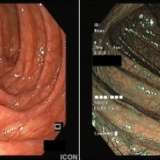
One study has attempted to characterise the endoscopic appearance of tylosis into mild, moderate and severe disease using both white light endoscopy (WLE) and narrow-band imaging (NBI).8 In this case series of 19 patients, mild tylosis of the oesophagus seen on WLE was described as mild and patchy hyperkeratosis, with intervening normal mucosa. A normal intrapapillary capillary loop (IPCL) pattern was seen under NBI. Severe tylosis was described as confluent hyperkeratotic plaques seen on WLE, and a severely distorted IPCL pattern seen under NBI. The 17 patients described as having mild or moderate tylosis based on the typical endoscopic findings showed no progression of the degree of dysplasia over a mean follow-up period of 30 months, whereas the 2 patients who were classified as having severe tylosis progressed to severe dysplasia, and ultimately underwent an oesophagectomy, following which early squamous cell carcinoma was confirmed in both resected specimens.8

References

  1. Ellis A, et al. Tylosis with oesophageal cancer: Diagnosis, management and molecular mechanisms. Orphanet J Rare Dis 2015; 10: 126. http://ojrd.biomedcentral.com/articles/10.1186/s13023-015-0346-2
  2. Maillefer RH & Greydanus MP. To B or not to B: is tylosis B truly benign? Two North American genealogies. Am J Gastroenterol 1999; 94: 829–834. http://www.nature.com/ajg/journal/v94/n3/abstract/ajg1999173a.html
  3. Howel-Evans W, et al. Carcinoma of the oesophagus with keratosis palmaris et plantaris (tylosis): a study of two families. Q J Med 1958; 27: 413–429. http://qjmed.oxfordjournals.org/content/27/3/413.long
  4. Ellis A, et al. Tylosis associated with carcinoma of the oesophagus and oral leukoplakia in a large Liverpool family—a review of six generations. Eur J Cancer B Oral Oncol 1994; 30B: 102–112. http://www.sciencedirect.com/science/article/pii/0964195594900612
  5. Blaydon DC, et al. RHBDF2 mutations are associated with tylosis, a familial esophageal cancer syndrome. Am J Hum Genet 2012; 90: 340–346. http://www.cell.com/ajhg/abstract/S0002-9297(11)00543-X
  6. Stevens HP, et al. Linkage of an American pedigree with palmoplantar keratoderma and malignancy (palmoplantar ectodermal dysplasia type III) to 17q24. Literature survey and proposed updated classification of the keratodermas. Arch Dermatol 1996; 132: 640–651. http://archderm.jamanetwork.com/article.aspx?articleid=557815
  7. Evans, JA, et al. The role of endoscopy in Barrett’s esophagus and other premalignant conditions of the esophagus. Gastrointest Endosc 2012; 76: 1087–1094. http://www.giejournal.org/article/S0016-5107(12)02574-6/abstract
  8. Smart H, et al. Defining the endoscopic appearances of tylosis using conventional and narrow-band imaging: a case series. Endoscopy 2011; 43: 727–730. https://www.thieme-connect.com/DOI/DOI?10.1055/s-0030-1256338
Social Sharing
  • About the Author
About the Author

Dr Ruchit Sood is an advanced endoscopy fellow at Leeds Teaching Hospitals, UK. He graduated from the University of Sheffield in 2005 and he commenced his postgraduate training in gastroenterology in 2009. He is in the process of completing a Doctorate of Medicine from the University of Leeds, and to date has published more than 20 peer-reviewed articles. His main interest is in advanced therapeutic endoscopy, in particular upper and lower gastrointestinal tract endoscopic mucosal resection.

Comment

Please log in with your myUEG account to post comments.

Related Articles
Mistakes in...
Mistakes in colonoscopy and how to avoid them
Press Release
New report reveals major health and economic impact of digestive diseases across Europe
Mistakes in...
Mistakes in polypectomy and how to avoid them
Mistakes in...
Mistakes in gastroscopy and how to avoid them
Latest Articles
Decide on the Spot
An elusive lesion in the colon
Decide on the Spot
A rare biopsy finding with many possible causes
Decide on the Spot
An incidental diagnosis by endoscopic ultrasound
Decide on the Spot
A not-so-black-and-white case of gastrointestinal bleeding
Get our newsletter!
Sign up with your email to receive UEG news and updates. We respect your privacy.

Headquarters Management

United European Gastroenterology

Wickenburggasse 1
1080 Vienna, Austria


T: +43 1 997 1639

UEG Week Registration

Mondial Congress & Events

Official UEG Week Registration Partner
Operngasse 20b
1040 Vienna, Austria


T: +43 1 58804 - 0

More

Imprint

Terms & Conditions

Media Policies

Privacy Policy

Accessibility Statement

Change cookie-settings

Social Media

7 767 Followers

23 000 Followers

15 666 Followers

5 866 Followers

3 670 Subscribers

11 399 Subscribers

65 Subscribers

409 Subscribers

UEG copyright 2025. All rights reserved. Use of this website constitutes acceptance of the Privacy Policy and Terms & Conditions.