• Offer for Industry
  • Young GI
  • Patients
  • Press
  • Newsletter
  • Contact us
UEG Connect
Create myUEG account
  • About
    • To landing page
      • Who we are
      • Boards, Committees & Groups
      • Governance
      • Headquarters Management
      • History
      • What we do
      • Strategic Drivers
      • Year in Review
      • Our Members
      • Specialist Member Societies
      • National Member Societies
      • UEG Community
      • UEG Associates
      • UEG Connect
      • Women in GI
      • Young GIs
      • Researchers
      • Event Calendar
  • Week
    • To landing page
      • Attendance
      • Programme
      • Abstract Submission
      • Postgraduate Teaching
      • Industry
      • Supporters
      • Congress Resources
      • UEG Week Recordings ↗
      • CME Accreditation
      • Future UEG Week
  • Education
    • To landing page
      • Gutflix - Learning Platform ↗
      • Online Courses ↗
      • Mistakes in... ↗
      • UEG Podcast ↗
      • Webinars ↗
      • Summer School
      • Masterclass
      • Gut Guide
      • Career Development
      • CME in Europe
      • Supporters
  • Research
    • To landing page
      • Horizon Europe Support
      • Start-up Grant
      • Research Projects
      • HoloSurge
      • Intercept
      • InfoGut COST Action
      • White Book 2
      • Main Results
      • Full Reports
      • Materials and Presentations
  • Quality of Care
    • To landing page
      • Search Guidelines ↗
      • Non-English Guidelines
      • How to Develop Guidelines ↗
      • Quality of Care Initiatives
      • Quality Indicators
  • Public Affairs
    • To landing page
      • News
      • Focus Areas
      • Advocacy Toolbox
      • Stakeholder Collaboration
      • Digestive Health Month
      • Position Papers
      • Advocacy Bulletin
      • #EUNewsline
      • MEP Digestive Health Group
  • Publications
    • To landing page
      • Congress Publications
      • Research Publications
      • Public Affairs Publications
      • Education Publications
      • UEG Publications
      • UEG Journal ↗
      • UEG Journal Podcast ↗
  • Opportunities
    • To landing page
      • Top Abstract Prizes
      • National Scholar Award
      • Travel Grants
      • International Scholarship Awards
      • Research Prize
      • Research Fellowship
      • Lifetime Achievement Award
      • Journal Best Paper Award
      • Activities Endorsement
      • Rising Star Awards
      • Clinical Visiting Fellowships
      • Open Positions
      • Talent Pool
  • Gutflix ↗
  • Offer for Industry
  • Young GI
  • Patients
  • Press
  • Newsletter
  • Contact us
Decide on the Spot

A suspicious swelling is seen!

September 01, 2016 | Nick Burr & Bjorn Rembacken

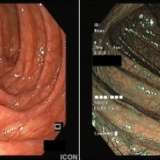
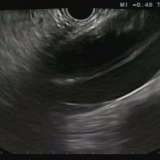
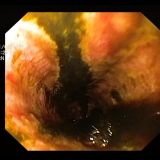
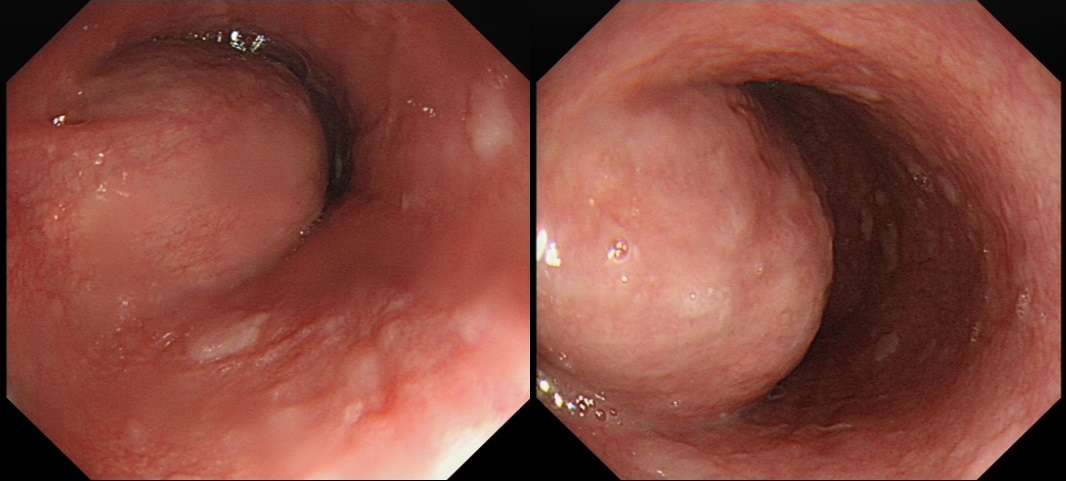
A 35-year-old man underwent an endoscopy because of dyspepsia. The endoscopy images show what was found in the low oesophagus. Surface biopsy samples revealed only normal squamous mucosa and for this reason an ultrasound and a CT scan were requested.

Case question 1

What is the most likely diagnosis?

a) Duplication cyst

b) Leiomyoma

c) Gastrointestinal stromal tumour (GIST)

d) Lipoma

e) Neuroendocrine tumour

  • Case question 1 answer and discussion
Case question 1 answer and discussion

Correct answer: a.

Discussion

The endoscopic images show a submucosal swelling in the distal oesophagus. Of course, the most likely diagnosis would be a leiomyoma. However, both the ultrasound and the CT show that the lesion is cystic.  Although a pericardial cyst would be a possibility, the only cystic lesion on the shortlist is the duplication cyst!

Gastrointestinal duplication cysts are formed during early embryonic development via abnormal budding or development of the primitive gut.1 These cysts are rare entities, with only two being found in one paediatric autopsy study of 4,000 patients.2 Because of their rarity, information on location, patient characteristics, complications and treatment outcomes is derived from case reports and small case series. They can occur at any point along the gastrointestinal tract and multiple lesions can be found throughout.3 Oesophageal duplication cysts are found as one of two separate entities, being either a distinct mass or in continuity with the oesophagus with duplication of the muscularis mucosa.3 Presentation typically occurs in early childhood with symptoms related to their anatomical location, namely dysphagia, nausea, vomiting, respiratory distress, retrosternal pain or more rarely cardiac dysfunction and arrhythmia.3 If the cyst contains gastric-type mucosa then haemorrhagic transformation or peptic ulceration leading to possible perforation can occur. Other known complications include infection and there have been rare case reports of malignant transformation.4

Duplication cysts can be seen on routine upper gastrointestinal endoscopy as submucosal lesions causing a bulge in the oesophageal lumen or a diverticulum. They are better characterized by cross-sectional imaging with CT or MRI. Endoscopic ultrasound can then be useful to examine the lesions in more detail and differentiate them from solid masses. The diagnosis is best made via radiological features alone as fine-needle aspiration can precipitate infection.

Typically, the management of duplication cysts is now performed surgically by video-assisted thorascopic surgery (VATS) with good outcomes and prognosis, but care must be taken as the cysts can share the blood supply of the normal bowel.3 There is a case report of a successful endoscopic procedure to ‘de-roof’ the cyst and leave the cystic cavity exposed to the oesophageal lumen.5 If asymptomatic, it is reasonable to leave the cysts in situ after discussion with the patient about the potential complications. Post-operatively there is no indication for surveillance in asymptomatic patients.

With increased use of endoscopy and cross-sectional imaging we may expect more reports of incidental oesophageal duplication cysts. For symptomatic patients with, for example, pain, dysphagia, compression of a bronchus or a complication such as inflammation, rupture or infection of the cyst, surgical intervention via VATS is less invasive than open surgery. Endoscopic procedures are possible, but there is limited evidence for their use in this setting. For asymptomatic patients, conservative management may be appropriate, leaving intervention until symptoms occur. Surveillance for incidental lesions is probably not warranted. A quick Medline review only revealed a single report, published more than 30 years ago, of a squamous cell carcinoma arising within an oesophageal duplication cyst.
References

  1. Nobuhara KK, Gorski YC, Quaglia MP La, et al. Bronchogenic cysts and esophageal duplications: Common origins and treatment. J Pediatr Surg 1997; 32: 1408–1413. http://www.jpedsurg.org/article/S0022-3468(97)90550-9/fulltext
  2. Potter EL. Pathology of the fetus and the infant. Chicago: Year Book Medical Publishers, 1961.
  3. Ildstad ST, Tollerud DJ, Weiss RG, et al. Duplications of the alimentary tract. Clinical characteristics, preferred treatment, and associated malformations. Ann Surg 1988; 208: 184–189. http://journals.lww.com/annalsofsurgery/Abstract/1988/08000/Duplications_of_the_Alimentary_Tract__Clinical.9.aspx
  4. Coit DG and Mies C. Adenocarcinoma arising within a gastric duplication cyst. J Surg Oncol 1992; 50: 274–277. http://onlinelibrary.wiley.com/doi/10.1002/jso.2930500417/abstract
  5. Will U, Meyer F and Bosseckert H. Successful endoscopic treatment of an esophageal duplication cyst. Scand J Gastroenterol 2005; 40: 995–999. http://www.tandfonline.com/doi/full/10.1080/00365520510023125
  6. Tapia RH and White VA. Squamous cell carcinoma arising in a duplication cyst of the esophagus. Am J Gastro 1985; 80: 325–329.
Social Sharing
  • About the Authors
About the Authors

Nick Burr is a Clinical Research Fellow in Leeds, where he is undertaking an MD investigating the long-term outcomes in patients with inflammatory bowel disease by using primary care data. His other interests are gastrointestinal haemorrhage and training in therapeutic endoscopy.

Bjorn Rembacken is at Leeds Teaching Hospitals NHS Trust, Leeds, UK. He was born in Sweden and qualified from Leicester University in 1987. He undertook his postgraduate education in Leicester and in Leeds. His MD was dedicated to inflammatory bowel disease. Dr Rembacken was appointed Consultant Gastroenterologist, Honorary Lecturer at Leeds University and Endoscopy Training Lead in 2005. Follow Bjorn on Twitter @Bjorn_Rembacken

Comment

Please log in with your myUEG account to post comments.

Related Articles
Mistakes in...
Mistakes in rumination syndrome and how to avoid them
Mistakes in...
Mistakes in chronic intestinal pseudo-obstruction and how to avoid them
Mistakes in...
Mistakes in colonoscopy and how to avoid them
Mistakes in...
Mistakes in faecal incontinence management and how to avoid them
Latest Articles
Decide on the Spot
An elusive lesion in the colon
Decide on the Spot
A rare biopsy finding with many possible causes
Decide on the Spot
An incidental diagnosis by endoscopic ultrasound
Decide on the Spot
A not-so-black-and-white case of gastrointestinal bleeding
Get our newsletter!
Sign up with your email to receive UEG news and updates. We respect your privacy.

Headquarters Management

United European Gastroenterology

Wickenburggasse 1
1080 Vienna, Austria


T: +43 1 997 1639

UEG Week Registration

Mondial Congress & Events

Official UEG Week Registration Partner
Operngasse 20b
1040 Vienna, Austria


T: +43 1 58804 - 0

More

Imprint

Terms & Conditions

Media Policies

Privacy Policy

Accessibility Statement

Change cookie-settings

Social Media

7 767 Followers

23 000 Followers

15 666 Followers

5 866 Followers

3 670 Subscribers

11 399 Subscribers

65 Subscribers

409 Subscribers

UEG copyright 2025. All rights reserved. Use of this website constitutes acceptance of the Privacy Policy and Terms & Conditions.