• Offer for Industry
  • Young GI
  • Patients
  • Press
  • Newsletter
  • Contact us
UEG Connect
Create myUEG account
  • About
    • To landing page
      • Who we are
      • Boards, Committees & Groups
      • Governance
      • Headquarters Management
      • History
      • What we do
      • Strategic Drivers
      • Year in Review
      • Our Members
      • Specialist Member Societies
      • National Member Societies
      • UEG Community
      • UEG Associates
      • UEG Connect
      • Women in GI
      • Young GIs
      • Researchers
      • Event Calendar
  • Week
    • To landing page
      • Attendance
      • Programme
      • Abstract Submission
      • Postgraduate Teaching
      • Industry
      • Supporters
      • Congress Resources
      • UEG Week Recordings ↗
      • CME Accreditation
      • Future UEG Week
  • Education
    • To landing page
      • Gutflix - Learning Platform ↗
      • Online Courses ↗
      • Mistakes in... ↗
      • UEG Podcast ↗
      • Webinars ↗
      • Summer School
      • Masterclass
      • Gut Guide
      • Career Development
      • CME in Europe
      • Supporters
  • Research
    • To landing page
      • Horizon Europe Support
      • Start-up Grant
      • Research Projects
      • HoloSurge
      • Intercept
      • InfoGut COST Action
      • White Book 2
      • Main Results
      • Full Reports
      • Materials and Presentations
  • Quality of Care
    • To landing page
      • Search Guidelines ↗
      • Non-English Guidelines
      • How to Develop Guidelines ↗
      • Quality of Care Initiatives
      • Quality Indicators
  • Public Affairs
    • To landing page
      • News
      • Focus Areas
      • Advocacy Toolbox
      • Stakeholder Collaboration
      • Digestive Health Month
      • Position Papers
      • Advocacy Bulletin
      • #EUNewsline
      • MEP Digestive Health Group
  • Publications
    • To landing page
      • Congress Publications
      • Research Publications
      • Public Affairs Publications
      • Education Publications
      • UEG Publications
      • UEG Journal ↗
      • UEG Journal Podcast ↗
  • Opportunities
    • To landing page
      • Top Abstract Prizes
      • National Scholar Award
      • Travel Grants
      • International Scholarship Awards
      • Research Prize
      • Research Fellowship
      • Lifetime Achievement Award
      • Journal Best Paper Award
      • Activities Endorsement
      • Rising Star Awards
      • Clinical Visiting Fellowships
      • Open Positions
      • Talent Pool
  • Gutflix ↗
  • Offer for Industry
  • Young GI
  • Patients
  • Press
  • Newsletter
  • Contact us
Decide on the Spot

A scary looking polyp

August 06, 2015 | Bjorn Rembacken

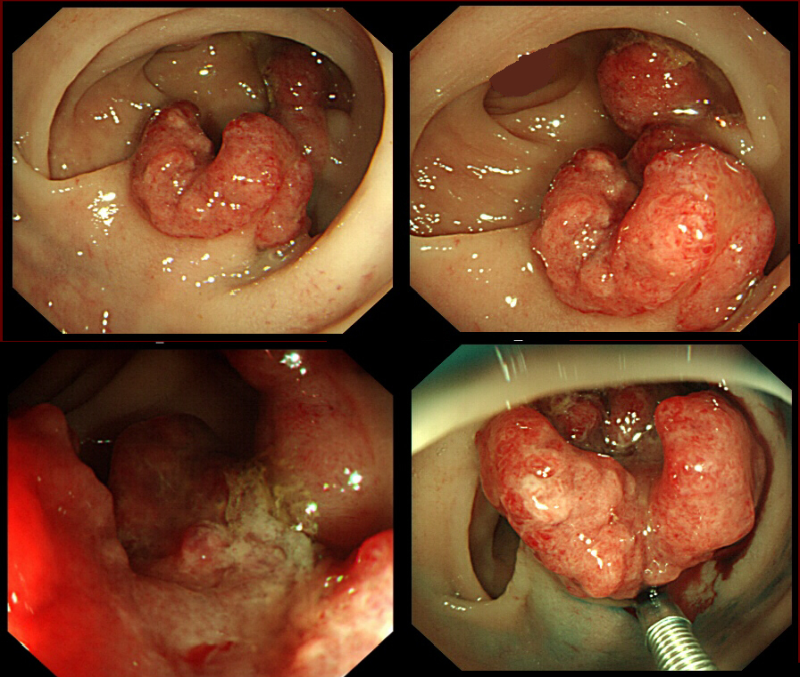
These four photographs show a polyp that was found in the high rectum of an elderly patient.

A scary polyp

Case Question 1

What would you do next?

a)     Take a full set of samples and wait for histology findings

b)     Take samples and request an endoscopic ultrasound (EUS)

c)     Take samples and request staging X-rays

d)     Resect the polyp endoscopically

e)     Refer the polyp for transanal resection

  • Case question 1 answer and discussion
Case question 1 answer and discussion

Correct answer: D.

Discussion

Clearly, this polyp is likely to be malignant. However, for some reason I decided to attempt a ‘test lift’ injection of colloid/adrenaline/indigo carmine dye into the submucosa. To my surprise the polyp lifted without any sign of tethering (bottom-right image) and I was able to remove it as a single fragment. The polyp turned out to be a tubular adenoma with a small spot of cancer in the centre.

Haggitt staging is the classic histological staging of the extent of invasion of cancers arising within pedunculated polyps.1 

  • Level 0 = Carcinoma in situ or intramucosal carcinoma (Haggitt level 0 lesions are not recognised in the UK because British histopathologists want to see malignant cells invading below the muscularis mucosa before they label a polyp as malignant).
  • Level 1 = Carcinoma invading through the muscularis mucosa into the submucosa, but limited to the head of the polyp.
  • Level 2 = Carcinoma invading the level of the neck of the adenoma.
  • Level 3 = Carcinoma invading any part of the stalk.
  • Level 4 = Carcinoma invading into the submucosa of the bowel wall below the stalk of the polyp, but above the muscularis propria.

Histopathologists may, however, be reluctant to apply the Haggitt classification because they can often have difficulty distinguishing the important boundaries between the head and neck and the neck and stalk of the polyp. These boundaries are arbitrary and subject to interobserver variability. Furthermore, if the stalk has been cut just below the head of the polyp, it will be impossible to diagnose a Haggitt level 4 lesion.

Naturally, all cancers staged as Haggitt level 4 are referred for further therapy. However, in Haggitt’s original publication, lymph-node metastases were also found in 6 out of 24 patients with Haggitt level 3 lesions.1

For flat lesions, cancers are staged using the Kikuchi classification.2 The risk of lymph-node metastasis for Kikuchi levels sm1, sm2 and sm3 is 2%, 8% and 23%, respectively.3 Unfortunately, it is difficult to use the Kikuchi system as there is normally no muscularis propria within the endoscopic resection fragment (unless you have cut too deep and perforated the colon of course).

In this particular case, the endoscopist would have noted that there is no discernable crypt pattern in the centre of the lesion. The endoscopist may well have made an endoscopic diagnosis of a ‘massively invasive cancer’ (i.e. cancer invading deeper than 1mm below the muscularis mucosa) and not have attempted resection. However, the detection of a suspicious crypt pattern (severely distorted crypt pattern or no pattern at all) has less relevance in pedunculated polyps, in which lesions can still be endoscopically resectable even if the tip of the lesion harbours a cancer.

This polyp is also a good example of the practical difficulties our histopathologists may encounter when attempting to apply the Haggitt and the Kikuchi staging systems. Is this lesion pedunculated or sessile? In this case it is neither, and neither the Haggitt nor the Kikuchi staging system applies! Because of such difficulties, Japanese histopathologists instead rely on simply measuring the depth of invasion beyond the muscularis mucosa.4 Lesions invading less than 0.5 mm (i.e. <500 µm), are regarded as Kikuchi level 1 (sm 1 invasion), 500–1,000 µm as level 2 invasion and >1,000 µm as level 3 invasion.

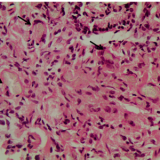
In this case, the depth of invasion was <500 µm and the deep margin was clear by several mm. In addition, no adverse features were found within the polyp (i.e. it was a well-differentiated cancer without any lymphovascular invasion). For these reasons, we decided not to offer the patient any further treatment beyond polypectomy.
References

  1. Haggitt RC, Glotzbach RE, Soffer EE, et al. Prognostic factors in colorectal carcinomas arising in adenomas: implications for lesions removed by endoscopic polypectomy. Gastroenterology 1985; 89: 328–336. http://www.gastrojournal.org/article/0016-5085(85)90333-6/abstract
  2. Kikuchi R, Takano M, Takagi K, et al. Management of early invasive colorectal cancer. Risk of recurrence and clinical guidelines. Dis Col Rect 1995; 38: 1286–1295. http://journals.lww.com/dcrjournal/Abstract/1995/38120/Management_of_early_invasive_colorectal_cancer_.9.aspx
  3. Nascimbeni R, Burgart LJ, Nivatvongs S, et al. Risk of lymph node metastasis in T1 carcinoma of the colon and rectum. Dis Col Rect 2002; 45: 200–206. http://journals.lww.com/dcrjournal/Abstract/2002/45020/Risk_of_Lymph_Node_Metastasis_in_T1_Carcinoma_of.8.aspx
  4. Ueno H, Mochizuki H, Hashiguchi Y, et al. Risk factors for an adverse outcome in early invasive colorectal carcinoma. Gastroenterology 2004; 127: 385–394. http://www.gastrojournal.org/article/S0016-5085(04)00717-6/abstract
Social Sharing
  • About the Author
About the Author

Bjorn Rembacken is at Leeds Teaching Hospitals NHS Trust, Leeds, UK. He was born in Sweden and qualified from Leicester University in 1987. He undertook his postgraduate education in Leicester and in Leeds. His MD was dedicated to inflammatory bowel disease. Dr Rembacken was appointed Consultant Gastroenterologist, Honorary Lecturer at Leeds University and Endoscopy Training Lead in 2005. Follow Bjorn on Twitter @Bjorn_Rembacken

Comment

Please log in with your myUEG account to post comments.

Latest Articles
Decide on the Spot
An elusive lesion in the colon
Decide on the Spot
A rare biopsy finding with many possible causes
Decide on the Spot
An incidental diagnosis by endoscopic ultrasound
Decide on the Spot
A not-so-black-and-white case of gastrointestinal bleeding
Get our newsletter!
Sign up with your email to receive UEG news and updates. We respect your privacy.

Headquarters Management

United European Gastroenterology

Wickenburggasse 1
1080 Vienna, Austria


T: +43 1 997 1639

UEG Week Registration

Mondial Congress & Events

Official UEG Week Registration Partner
Operngasse 20b
1040 Vienna, Austria


T: +43 1 58804 - 0

More

Imprint

Terms & Conditions

Media Policies

Privacy Policy

Accessibility Statement

Change cookie-settings

Social Media

7 767 Followers

23 000 Followers

15 666 Followers

5 866 Followers

3 670 Subscribers

11 399 Subscribers

65 Subscribers

409 Subscribers

UEG copyright 2025. All rights reserved. Use of this website constitutes acceptance of the Privacy Policy and Terms & Conditions.