Research Fellowships

Empowering early-career researchers across Europe

Take the next step for your scientific career

UEG offers a prestigious €50,000 fellowship for two researchers to spend 12 months working with a renowned European principal investigator.
 
The UEG Research Fellowship is designed to support the development of a basic or clinical research project while offering an opportunity to enhance scientific skills in a prominent research environment. It is especially suitable for early-career researchers looking to broaden their expertise beyond their current institution.
 
We strongly encourage early-career researchers, especially those from Inclusiveness Target Countries (as defined for COST Actions) to apply!

The call for applications for the Research Fellowships 2027 will open in June 2026. 

Research Fellowship

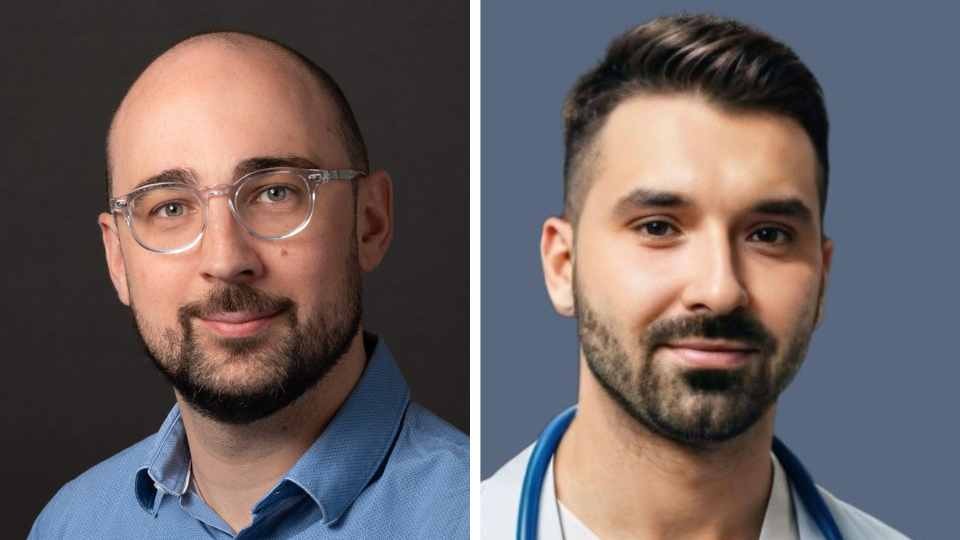
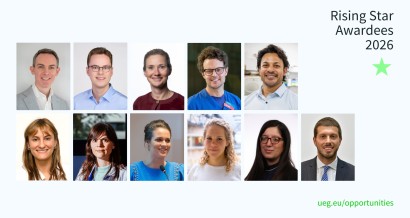
Research Fellows 2026: Robert Klimkowski & Pierre-Antoine Soret

Robert Klimkowski was awarded the UEG Research Fellowship 2026 to conduct his research on hyperspectral endoscopy for early detection of neoplasia in Barrett’s oesophagus at the Early Cancer Institute, University of Cambridge, UK, under the supervision of Dr. Massimiliano Di Pietro.  

Robert is a gastroenterology trainee and PhD candidate at the National Research Institute of Oncology in Warsaw, Poland directed by Prof. Michal F. Kaminski. His research focuses on early cancer detection, advanced endoscopic imaging, and minimally invasive therapies in oesophageal neoplasia. He is actively involved in international clinical studies and has presented his work at leading conferences, including winning the Young Talent Award at EndoSwiss 2025 conference in Zurich, Switzerland.  


Pierre-Antoine Soret was awarded the UEG Research Fellowship 2026 to conduct his research on “Strictures and malignancy in the biliary tree – improving the outcome in primary sclerosing cholangitis (PSC)” at Karolinska Institutet, Stockholm, Sweden, with Prof. Annika Bergquist.  

Pierre-Antoine is a physician-scientist working in the Department of Hepatology at Saint-Antoine Hospital and Sorbonne University in Paris, France, under the supervision of Prof. Sara Lemoinne. During his PhD, he studied the role of the necroptosis cell death pathway in the pathophysiology of PSC. He now focuses his research on developing new therapeutic approaches for chronic biliary diseases. He is also involved in the genetic characterization of intrahepatic cholelithiasis and adult indeterminate chronic cholestasis.

Research Fellowship Awardees 2026
Pierre-Antoine Soret (left), Robert Klimkowski (right)
  • Past awardees
Past awardees

2025: Yasmina Chouik from Hospices Civils de Lyon, Lyon, France.
Research Fellowship with principal investigator Prof. Frank Tacke at Charité – Universitätsmedizin Berlin, Germany. Research project: “In-depth characterisation of intrahepatic inflammation in human metabolic dysfunction-associated steatohepatitis (MASH)”.

2025: Varol Tunali from Celal Bayar University, Türkiye.
Research Fellowship with principal investigator Prof. Gianluca Ianiro at Fondazione Policlinico Universitario Gemelli IRCCS, Università Cattolica del Sacro Cuore, Rome, Italy. Research project: “Artificial intelligence-assisted personalised donor selection for faecal microbiota transplantation in irritable bowel syndrome”.

2024: André Simão from University of Lisbon, Lisbon, Portugal. 
Research Fellowship with principal investigator Prof. Jesús Bañales at the Biogipuzkoa Health Research Institute, Donostia Univ. Hospital, San Sebastian, Spain. Research project: "Serum microRNAs as Biomarkers of Metabolic Dysfunction-Associated Steatotic Liver Disease and Progression towards Cholangiocarcinoma".

2024: Katarzyna Radke from Lund University, Sweden.
Research Fellowship with principal investigator Prof. Luis Arnes Perez at the University of Copenhagen's Biotech Research and Innovation Center (BRIC), Denmark. Research project: "Precision therapy in pancreatic ductal adenocarcinoma: integrating strategies to combat resistance". 

2023: Angelo Armandi from University of Turin, Italy.
Research Fellowship with principal investigator Jörn M. Schattenberg at the Saarland University, Saarbrücken, Germany. Research project: “Immune activation and the liver-spleen axis in Non-Alcoholic Steatohepatitis”

2022: Antonio Molinaro from Sahlgrenska University Hospital, Gothenburg, Sweden.
Research Fellowship with principal investigator Tom Hemming Karlsen at the Norwegian PSC Research Center (NoPSC), Institute of Clinical Medicine, Oslo, Norway. Research project: “Investigating The Role Of Imidazole Propionate In The Pathogenesis Of Primary Sclerosing Cholangitis”

2021: Lucas Wauters from KU Leuven, Belgium.
Research Fellowship with principal investigator Francisca Joly at the Department of Gastroenterology and Nutrition Support at Beaujon Hospital, Clichy, France. Research project: “Sarcopenia and short bowel syndrome: the microbiota-gut-muscle axis”

2020: Chloé Melchior from Rouen University, France.
Research Fellowship with principal investigator Magnus Simrén at Sahlgrenska Academy, University of Gothenburg. Research Project: “A new gas-sensing capsule to understand the mechanisms of fructan-induced symptoms in IBS, and the link to gut microbiota composition and function”
Watch the UEG Week 2022 presentation "Digestive diseases: Big burden, low funding?" with Chloé Melchior.

2019: Michal Zorniak from Medical University of Silesia.
Research Fellowship with principal investigator Julia Mayerle at Ludwig-Maximilians University, Munich Research Project: “Role of biliary microlithiasis-induced NLRP3-inflammasome activation for papillitis and the development of pancreatitis”
Target group

The grant is open to both basic and clinical researchers, and to both medical and non-medical graduates.

At the time of application, applicants for the programme must:

  • be a UEG Associate
  • be clinical or basic researchers specialised in digestive diseases according to their track record
     
  • Applicants must either: 
    • have completed their PhD (no longer than five years ago), OR 
    • be in gastroenterology, hepatology, or surgery training, or have completed such training within the last five years*
  • not holding an academic permanent position
  • have proven research experience (according to their track record)
  • be fluent in English
  • reside in Europe, in a country bordering the Mediterranean Sea, or in a country represented by a UEG National Member Society 

*Please note that for main carers of children, the five-year limit can be extended to seven years for one child or nine years for two children.

Provided the basic criteria are fulfilled, one fellowship is to be assigned to a top-ranked candidate from an Inclusiveness Target Country (as defined for COST Actions). Final decision remains with the Research Committee. 

The grant will be awarded to the same recipient only once. 

List of potential host institutions

This list of host research institutions is provided solely as a resource for UEG Research Fellowship applicants to identify potential hosts aligned with their research interests. Inclusion does not imply UEG endorsement or guarantee acceptance. Applicants may also choose any suitable institution not listed. Applicants must contact and secure a host institution before beginning the application process. UEG does not facilitate matching between applicants and host institutions.

Download list of potential host institutions


Contact
Research EU Project Management
Henrich Hipca