• Offer for Industry
  • Young GI
  • Patients
  • Press
  • Newsletter
  • Contact us
UEG Connect
Create myUEG account
  • About
    • To landing page
      • Who we are
      • Boards, Committees & Groups
      • Governance
      • Headquarters Management
      • History
      • What we do
      • Strategic Drivers
      • Year in Review
      • Our Members
      • Specialist Member Societies
      • National Member Societies
      • UEG Community
      • UEG Associates
      • UEG Connect
      • Women in GI
      • Young GIs
      • Researchers
      • Event Calendar
  • Week
    • To landing page
      • Attendance
      • Programme
      • Abstract Submission
      • Postgraduate Teaching
      • Industry
      • Supporters
      • Congress Resources
      • UEG Week Recordings ↗
      • CME Accreditation
      • Future UEG Week
  • Education
    • To landing page
      • Gutflix - Learning Platform ↗
      • Online Courses ↗
      • Mistakes in... ↗
      • UEG Podcast ↗
      • Webinars ↗
      • Summer School
      • Masterclass
      • Gut Guide
      • Career Development
      • CME in Europe
      • Supporters
  • Research
    • To landing page
      • Horizon Europe Support
      • Start-up Grant
      • Research Projects
      • HoloSurge
      • Intercept
      • InfoGut COST Action
      • White Book 2
      • Main Results
      • Full Reports
      • Materials and Presentations
  • Quality of Care
    • To landing page
      • Search Guidelines ↗
      • Non-English Guidelines
      • How to Develop Guidelines ↗
      • Quality of Care Initiatives
      • Quality Indicators
  • Public Affairs
    • To landing page
      • News
      • Focus Areas
      • Advocacy Toolbox
      • Stakeholder Collaboration
      • Digestive Health Month
      • Position Papers
      • Advocacy Bulletin
      • #EUNewsline
      • MEP Digestive Health Group
  • Publications
    • To landing page
      • Congress Publications
      • Research Publications
      • Public Affairs Publications
      • Education Publications
      • UEG Publications
      • UEG Journal ↗
      • UEG Journal Podcast ↗
  • Opportunities
    • To landing page
      • Top Abstract Prizes
      • National Scholar Award
      • Travel Grants
      • International Scholarship Awards
      • Research Prize
      • Research Fellowship
      • Lifetime Achievement Award
      • Journal Best Paper Award
      • Activities Endorsement
      • Rising Star Awards
      • Clinical Visiting Fellowships
      • Open Positions
      • Talent Pool
  • Gutflix ↗
  • Offer for Industry
  • Young GI
  • Patients
  • Press
  • Newsletter
  • Contact us
Decide on the Spot

A curious case of colitis

September 16, 2015 | Bjorn Rembacken

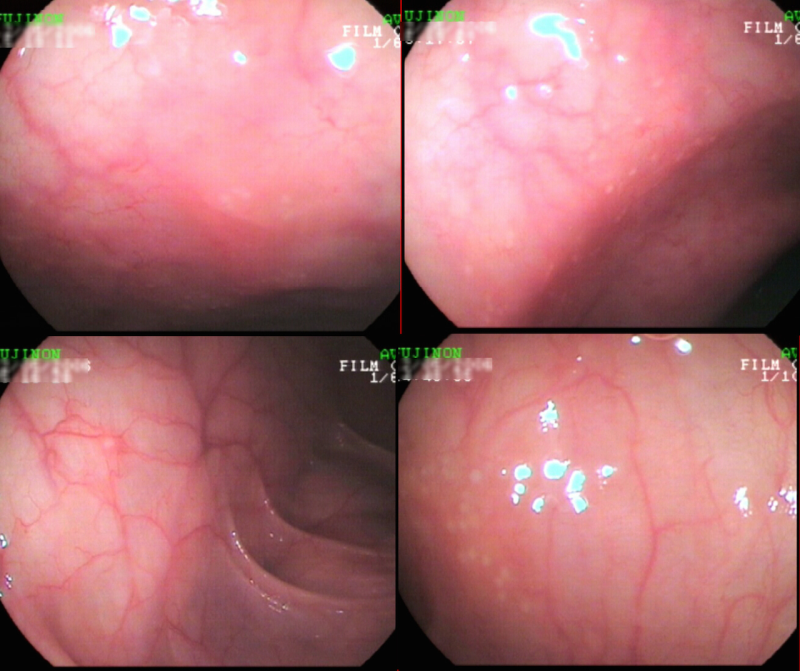
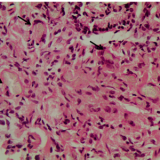
A 45-year-old Chinese woman presented with a 2-year history of intermittent loose stools, occasional PR bleeding and abdominal pain. The mucosal patches seen on the photograph were found in the left side of the colon. A full set of mucosal biopsy samples were taken and a representative histology slide, stained with H&E, is also shown.

A curious case of colitis

Case Question 1

What is the most likely diagnosis?

a) Schistosomal colitis

b) Crohn’s colitis

c) Ulcerative colitis

d) Ischaemic colitis

e) Amoebic colitis

  • Case question 1 answer and discussion
Case question 1 answer and discussion

Correct answer: a.

Discussion

The mucosal patches shown on the photograph have been referred to as ‘sandy patches’ and when seen are pathognomonic of chronic schistosomal colitis! The arrow on the histology slide shows a Schistosoma egg in the colonic lamina propria.

Among human parasitic diseases, schistosomiasis ranks second to malaria in terms of socioeconomic and public health importance. The three main species of schistosome that infect humans are Schistosoma haematobium and Schistosoma mansoni, which are found in Africa and the Middle East, and Schistosoma japonicum, which is localised to Asia, particularly the Philippines and China.1

As you may already know, schistosome eggs are passed in the faeces or urine (S. haematobium) of infected people and hatch into larvae in fresh water. These larvae penetrate freshwater snails and multiply. Four to six weeks later free-living cercariae are released from the snail and are able to penetrate human skin within 20 seconds. Immature schistosomes migrate via the lungs to reach mesenteric veins (or the vesical plexus in the case of S. haematobium infestation). Here, adult worms mature and produce 1,500–3,000 eggs per day for the next 5 years or so. Eggs are released through venular walls to reach the colon or bladder and are excreted in the faeces or urine.

Surprisingly, it is the schistosome eggs (rather than the worms) that induce the morbidity of schistosomiasis. This is because many eggs are not excreted but become permanently lodged in the intestines, liver or urogenital system. Here they induce a chronic granulomatous reaction, and fibrosis.

Chronic schistosomal colitis is a nonspecific condition that presents with intermittent abdominal pain, diarrhoea and rectal bleeding.2 Colonoscopy in patients with acute schistosomal colitis may reveal an oedematous, congested mucosa and petechial haemorrhages. In those who have chronic schistosomal colitis, the most characteristic finding is the grey-yellow or yellowish white schistosomal nodules (shown in the images). Although these findings are typical, there were only found in 16% of cases in a review of 46 patients published by Cao and colleagues.3

Three distinct syndromes are associated with schistosomiasis. “Swimmers itch” may occur when cercariae penetrate the skin (although itching is more frequently associated with cercariae of nonhuman schistosomes). “Katayama fever” occurs after egg production commences and is probably attributable to the formation of immune complexes in response to the antigenic stimulus provoked by the eggs. Pyrexia, lymphadenopathy, splenomegaly and eosinophilia are common. Finally, liver cirrhosis with portal hypertension is caused by eggs carried to the liver from the intestine; fibrosis of the bladder wall and urogenital system can result in hydronephrosis and renal failure.

The diagnosis of chronic schistosomal colitis is made by identifying eggs in faeces or colonic biopsy samples. Serum antibody detection is of value in travellers returning from endemic areas, whereas antigen detection techniques are useful in distinguishing between past and current infection in indigenous populations.

Praziquantel is effective against all five schistosome species and is the drug of choice. Up to 80% of adults are cured after a day's treatment. However, cure rates are far lower among preschool children. This is perhaps because praziquantel tablets are large and bitter tasting and often cause transient abdominal pain, headache and dizziness. As praziquantel is not active against juvenile worms, people who are not living in endemic areas are offered a repeat course 3–6 weeks after the first dose to kill the initially resistant immature worms. In endemic regions, praziquantel is often offered once a year or so to suppress morbidity.
References

  1. Colley DG, Bustinduy AL, Secor WE, et al. Human schistosomiasis. Lancet 2014; 383: 2253–2264. http://www.thelancet.com/journals/lancet/article/PIIS0140-6736(13)61949-2/abstract
  2. Mohamed AR, al Karawi M, and Yasawy MI. Schistosomal colonic disease. Gut 1990; 31: 439–442. http://gut.bmj.com/content/31/4/439.abstract?sid=a3825852-676b-4ae0-8095-8c95f36eab06
  3. Cao J, Liu WJ, Xu X, et al. Endoscopic findings and clinicopathologic characteristics of colonic schistosomiasis: A report of 46 cases. World J Gastroenterol 2010; 16: 723–727. http://www.wjgnet.com/1007-9327/full/v16/i6/723.htm
Social Sharing
  • About the Author
About the Author

Bjorn Rembacken is at Leeds Teaching Hospitals NHS Trust, Leeds, UK. He was born in Sweden and qualified from Leicester University in 1987. He undertook his postgraduate education in Leicester and in Leeds. His MD was dedicated to inflammatory bowel disease. Dr Rembacken was appointed Consultant Gastroenterologist, Honorary Lecturer at Leeds University and Endoscopy Training Lead in 2005. Follow Bjorn on Twitter @Bjorn_Rembacken

Comment

Please log in with your myUEG account to post comments.

Latest Articles
Decide on the Spot
An elusive lesion in the colon
Decide on the Spot
A rare biopsy finding with many possible causes
Decide on the Spot
An incidental diagnosis by endoscopic ultrasound
Decide on the Spot
A not-so-black-and-white case of gastrointestinal bleeding
Get our newsletter!
Sign up with your email to receive UEG news and updates. We respect your privacy.

Headquarters Management

United European Gastroenterology

Wickenburggasse 1
1080 Vienna, Austria


T: +43 1 997 1639

UEG Week Registration

Mondial Congress & Events

Official UEG Week Registration Partner
Operngasse 20b
1040 Vienna, Austria


T: +43 1 58804 - 0

More

Imprint

Terms & Conditions

Media Policies

Privacy Policy

Accessibility Statement

Change cookie-settings

Social Media

7 767 Followers

23 000 Followers

15 666 Followers

5 866 Followers

3 670 Subscribers

11 399 Subscribers

65 Subscribers

409 Subscribers

UEG copyright 2025. All rights reserved. Use of this website constitutes acceptance of the Privacy Policy and Terms & Conditions.