• Offer for Industry
  • Young GI
  • Patients
  • Press
  • Newsletter
  • Contact us
UEG Connect
Create myUEG account
  • About
    • To landing page
      • Who we are
      • Boards, Committees & Groups
      • Governance
      • Headquarters Management
      • History
      • What we do
      • Strategic Drivers
      • Year in Review
      • Our Members
      • Specialist Member Societies
      • National Member Societies
      • UEG Community
      • UEG Associates
      • UEG Connect
      • Women in GI
      • Young GIs
      • Researchers
      • Event Calendar
  • Week
    • To landing page
      • Attendance
      • Registration fees
      • Hotel
      • Venue
      • Eco-friendly info
      • Programme
      • Abstract Submission
      • DDM Summit
      • Postgraduate Teaching
      • Industry
      • Supporters
      • Congress Resources
      • UEG Week Recordings ↗
      • CME Accreditation
      • Future UEG Week
  • Education
    • To landing page
      • Gutflix - Learning Platform ↗
      • Online Courses ↗
      • Mistakes in... ↗
      • UEG Podcast ↗
      • Webinars
      • Summer School
      • Masterclass
      • Gut Guide
      • Career Development
      • CME in Europe
      • Supporters
  • Research
    • To landing page
      • Horizon Europe Support
      • Start-up Grant
      • Research Projects
      • HoloSurge
      • Intercept
      • InfoGut COST Action
      • White Book 2
      • Main Results
      • Full Reports
      • Materials and Presentations
  • Quality of Care
    • To landing page
      • Search Guidelines ↗
      • Non-English Guidelines
      • How to Develop Guidelines ↗
      • Quality of Care Initiatives
      • Quality Indicators
  • Public Affairs
    • To landing page
      • News
      • Focus Areas
      • Advocacy Toolbox
      • Stakeholder Collaboration
      • Digestive Health Month
      • Position Papers
      • Advocacy Bulletin
      • #EUNewsline
      • MEP Digestive Health Group
  • Publications
    • To landing page
      • Congress Publications
      • Research Publications
      • Public Affairs Publications
      • Education Publications
      • UEG Publications
      • UEG Journal ↗
      • UEG Journal Podcast ↗
  • Opportunities
    • To landing page
      • Top Abstract Prizes
      • National Scholarships
      • Travel Grants
      • International Scholarships
      • Research Prize
      • Research Fellowships
      • Lifetime Achievement Award
      • Journal Best Paper Award
      • Activities Endorsement
      • Rising Star Awards
      • Clinical Visiting Fellowships
      • Open Positions
      • Talent Pool
  • Gutflix ↗
  • Offer for Industry
  • Young GI
  • Patients
  • Press
  • Newsletter
  • Contact us
Decide on the Spot

The hot PET

October 24, 2015 | Monzur Ahmed

A 72-year-old man previously presented with obstructive bowel symptoms. He was diagnosed with mantle cell lymphoma—a type of non-Hodgkin lymphoma—with involvement of the rectosigmoid junction and terminal ileum.

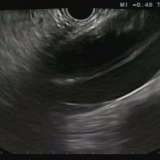
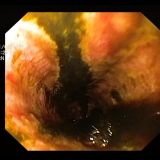
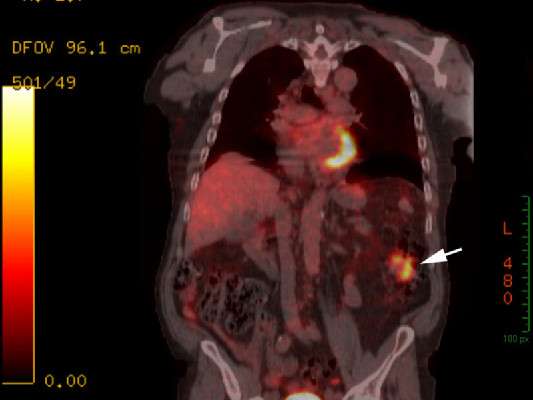
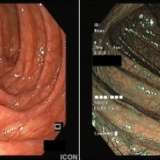
He underwent a left hemicolectomy and resection of the terminal ileum followed by chemotherapy (fludarabine, mitoxantrone, dexamethasone and rituximab). After treatment he went into prolonged remission and follow-up colonoscopies 5 years and 7 years later were both unremarkable. The findings of a gastroscopy and capsule endoscopy were also normal 7 years after treatment, at which time the patient was asymptomatic with normal blood results. His haematologist requested a surveillance FDG PET-CT scan, which demonstrated a hot spot in the descending colon (figure 1). A further colonoscopy was carried out and showed 2 polyps in the descending colon (figure 2; DC1 [15mm] and DC2 [50 mm]). The ileocolonic anastomosis and neoterminal ileum were both unremarkable.

Figure 1 | FDG PET-CT SCAN showing two areas of increased activity in the descending colon (arrow).
  • Case Question 1
  • Case question 1 answer and discussion
Case Question 1

WHAT WOULD YOU DO WITH THESE POLYPS?

a) Ignore them, as they are inflammatory.

b) Take biopsy samples only.

c) Perform standard snare polypectomy.

d) Organise an endoscopic mucosal resection (EMR).

e) Organise an endoscopic submucosal dissection (ESD).
Case question 1 answer and discussion

Correct answer: b. 

Discussion

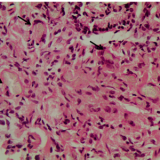
The polyps found in the case patient are likely to be recurrent gastrointestinal mantle cell lymphoma (MCL). To confirm the diagnosis, biopsy samples must be taken and immunohistochemistry performed. In this case immunohistochemistry indeed confirmed MCL. The polyps were lymphomatous submucosal lesions that were not suitable for endoscopic resection.

MCL is a type of mature B-cell non-Hodgkin lymphoma (NHL) that comprises 3–10% of NHLs in Europe and the USA.1,2 In MCL, the malignant cells are thought to originate from marginal-zone peripheral-blood memory B cells.3 The median age at presentation is 68 years and there is a male preponderance. In 75% of cases, patients with MCL present with lymphadenopathy, whilst 25% have extra-nodal disease. Common extra-nodal sites include the spleen, bone marrow, Waldeyer’s ring, gastrointestinal tract, breast, pleura and orbit.

MCL can involve any region of the gut and in one series of 31 cases, gut involvement was as follows: stomach (57%), duodenum (52%), jejunum/ileum (87%), colon (90%) and rectum (65%).4 In 28 of 31 cases lymphomatous submucosal nodules producing polypoid lesions were found in both the small and large bowel. These polypoid lesions may be seen at endoscopy (as was the case here) and measure from 2mm to several cm in diameter. Some of the polyps may be ulcerated. The polyps can involve more than one segment of the gut with or without normal intervening mucosa. Immunohistochemistry is essential to distinguish MCL from other small B-cell lymphoid proliferation.5 Peripheral and gastrointestinal MCL has a characteristic phenotype: CD20+, CD5+ and cyclin D1+ and CD10–.

Primary MCL of the gastrointestinal tract carries a poor prognosis. Combination chemotherapy and immunotherapy remains the main treatment modality with or without high-dose therapy with haematopoietic stem-cell transplantation.6 Surgery is usually not of benefit but may be necessary in patients with bowel obstruction or intractable bleeding. Radiotherapy is normally reserved for palliation. Therapy for MCL is not curative and virtually all patients will have refractory or recurrent disease. Treatment of recurrent MCL involves salvage chemotherapy, preferably in the context of a clinical trial.

References

  1. Anderson JR, Armitage JO and Weisenburger DD. Epidemiology of the non-Hodgkin’s lymphomas: distributions of the major subtypes differ by geographical locations. Non- Hodgkins Lymphoma Classification Project. Ann Oncol 1998; 9: 717–720. http://annonc.oxfordjournals.org/content/9/7/717.abstract
  2. Zhou Y, Wang H, Fang W, et al. Incidence trends of mantle cell lymphoma in the United States between 1992 and 2004. Cancer 2008; 113: 791–798. http://onlinelibrary.wiley.com/doi/10.1002/cncr.23608/abstract
  3. Bertoni F and Ponzoni M. The cellular origin of mantle cell lymphoma. Int J Biochem & Cell Biol 2007; 39: 1747–1753. 
  4. Ruskone-Fourmestraux A, Delmer A, Lavergne A, et al. Multiple lymphomatous polyposis of the gastrointestinal tract: prospective clinicopathologic study of 31 cases. Groupe D’etude des Lymphomes Digestifs. Gastroenterology 1997; 112: 7–16. http://www.gastrojournal.org/article/S0016-5085(97)70212-9/abstract
  5. Ruskone-Fourmestraux A and Audouin J. Primary gastrointestinal tract mantle cell lymphoma as multiple lymphomatous polyposis. Best Practice & Research Clinical Gastroenterology 2010; 24: 35–42. http://www.sciencedirect.com/science/article/pii/S1521691809001541
  6. McKay P, Leach M, Jackson R et al. Guidelines for the investigation and management of mantle cell lymphoma. Br J Haematol. 2012; 159: 405–426. http://onlinelibrary.wiley.com/doi/10.1111/bjh.12046/abstract
Social Sharing
  • About the Author
About the Author

Monzur Ahmed is a consultant gastroenterologist in the Department of Gastroenterology, Good Hope Hospital, Birmingham, UK. He graduated with BSc (Hons), MBChB in 1987 from the University of Birmingham, UK. He obtained an MD in 1997 for his research into viral hepatitis and was appointed as a consultant in 1999. He has an interest in advanced therapeutic endoscopy and leads the Trust’s Bowel Cancer Screening Programme.

Comment

Please log in with your myUEG account to post comments.

Latest Articles
Decide on the Spot
An elusive lesion in the colon
Decide on the Spot
A rare biopsy finding with many possible causes
Decide on the Spot
An incidental diagnosis by endoscopic ultrasound
Decide on the Spot
A not-so-black-and-white case of gastrointestinal bleeding
Get our newsletter!
Sign up with your email to receive UEG news and updates. We respect your privacy.

Headquarters Management

United European Gastroenterology

Wickenburggasse 1
1080 Vienna, Austria


T: +43 1 997 1639

UEG Week Registration

Mondial Congress & Events

Official UEG Week Registration Partner
Operngasse 20b
1040 Vienna, Austria


T: +43 1 58804 - 0

More

Imprint

Terms & Conditions

Media Policies

Privacy Policy

Accessibility Statement

Change cookie-settings

Social Media

7 767 Followers

23 000 Followers

15 666 Followers

5 866 Followers

3 670 Subscribers

11 399 Subscribers

65 Subscribers

409 Subscribers

UEG copyright 2026. All rights reserved. Use of this website constitutes acceptance of the Privacy Policy and Terms & Conditions.