• Offer for Industry
  • Young GI
  • Patients
  • Press
  • Newsletter
  • Contact us
UEG Connect
Create myUEG account
  • About
    • To landing page
      • Who we are
      • Boards, Committees & Groups
      • Governance
      • Headquarters Management
      • History
      • What we do
      • Strategic Drivers
      • Year in Review
      • Our Members
      • Specialist Member Societies
      • National Member Societies
      • UEG Community
      • UEG Associates
      • UEG Connect
      • Women in GI
      • Young GIs
      • Researchers
      • Event Calendar
  • Week
    • To landing page
      • Congress Resources
      • UEG Week Recordings ↗
      • CME Accreditation
      • Future UEG Week
      • Programme
      • Postgraduate Teaching
      • Industry
      • Supporters
  • Education
    • To landing page
      • Gutflix - Learning Platform ↗
      • Online Courses ↗
      • Mistakes in... ↗
      • UEG Podcast ↗
      • Webinars ↗
      • Summer School
      • Masterclass
      • Gut Guide
      • Career Development
      • CME in Europe
      • Supporters
  • Research
    • To landing page
      • Horizon Europe Support
      • Start-up Grant
      • Research Projects
      • HoloSurge
      • Intercept
      • InfoGut COST Action
      • White Book 2
      • Main Results
      • Full Reports
      • Materials and Presentations
  • Quality of Care
    • To landing page
      • Search Guidelines ↗
      • Non-English Guidelines
      • How to Develop Guidelines ↗
      • Quality of Care Initiatives
      • Quality Indicators
  • Public Affairs
    • To landing page
      • News
      • Focus Areas
      • Advocacy Toolbox
      • Stakeholder Collaboration
      • Digestive Health Month
      • Position Papers
      • Advocacy Bulletin
      • #EUNewsline
      • MEP Digestive Health Group
  • Publications
    • To landing page
      • Congress Publications
      • Research Publications
      • Public Affairs Publications
      • Education Publications
      • UEG Publications
      • UEG Journal ↗
      • UEG Journal Podcast ↗
  • Opportunities
    • To landing page
      • Top Abstract Prizes
      • National Scholar Award
      • Travel Grants
      • International Scholarship Awards
      • Research Prize
      • Research Fellowship
      • Lifetime Achievement Award
      • Journal Best Paper Award
      • Activities Endorsement
      • Rising Star Awards
      • Clinical Visiting Fellowships
      • Open Positions
      • Talent Pool
  • Gutflix ↗
  • Offer for Industry
  • Young GI
  • Patients
  • Press
  • Newsletter
  • Contact us
Press Release

UEG Week: Faecal microbiota transplantation is effective in irritable bowel syndrome, but having a ‘super-donor’ is essential

October 21, 2019
UEG Week: Faecal microbiota transplantation is effective in irritable bowel syndrome, but having a ‘super-donor’ is essential
UEG Week

The results of a large, randomised, double-blind, placebo-controlled study have confirmed that faecal microbiota transplantation (FMT) using a single ‘super-donor’ is an effective and well tolerated treatment for irritable bowel syndrome (IBS), producing high rates of clinical response and marked symptom improvements. The study reported today, which involved a large cohort of patients with various subtypes of IBS, used several enhanced methodologies, and highlighted the importance of donor selection for optimising the effectiveness of FMT as a treatment for IBS. 

Speaking at UEG Week Barcelona 2019, lead investigator, Professor Magdy El-Salhy from Haukeland University Hospital in Bergen, Norway, explained: “Microbiota dysbiosis is thought to play an important role in the pathophysiology of IBS, however, previous studies investigating FMT in this condition have produced conflicting results. 

“We set out to optimise our chances of treatment success by selecting a single, well-defined donor* who fulfilled European guidelines for FMT donors, and who had a favourable faecal microbial profile.” 

The study randomized 164 individuals with IBS and moderate-to-severe IBS symptoms (Irritable Bowel Syndrome Severity Scoring System [IBS-SSS] ≥175) to receive either placebo (a solution containing their own faeces), a 30 g donor transplant solution, or a 60 g transplant solution. Unlike in previous studies, the transplant material had been stored frozen (–80 °C/–112 °F), and was administered after thawing into the proximal duodenum via gastroscope – obviating the need for bowel preparation prior to transplantation and making it easier to perform in clinical practice. The primary efficacy endpoint of the study was the percentage of patients who achieved a ≥50-point reduction in IBS-SSS at 3 months after FMT (response to treatment). 

According to Prof. El-Salhy, a response to FMT treatment was observed in 23.6% of individuals who received placebo, 76.9% of individuals who received a 30 g transplant, and 89.1% of individuals who received a 60 g transplant. Clinically significant symptom improvement [a ≥175-point reduction in IBS-SSS] occurred in 5.5%, 35.2%, and 47.3% of individuals in the placebo, FMT 30 g and FMT 60 g treatment groups, respectively. Significant improvements in fatigue (Fatigue Assessment Scale) and quality of life (IBS-Quality of Life instrument) were also observed in the FMT treatment groups compared with the placebo group. An analysis of faecal bacterial profiles showed changes in the abundance of different bacteria in the two FMT groups, but not in the control group. 

“Adverse events after FMT occurred in about 20% of patients and were mild and self-limiting gastrointestinal symptoms such as abdominal pain, diarrhoea or constipation,” said Prof. El-Salhy. “These occurred intermittently in the first 2 days following FMT.” 

Prof El-Salhy and colleagues believe this study confirms that FMT is an effective treatment for IBS, but stress the importance of using a super-donor to achieve treatment success. “We got lucky when we found our donor after screening several other candidates, and we hope the selection criteria we used will help other groups find similar individuals,” noted Prof. El-Salhy. “The use of frozen faeces eliminates the logistical problems associated with FMT involving fresh faeces, making it possible to establish bio-banks for the routine use of FMT in clinical practice.” 

Social Sharing
  • About UEG
  • About UEG Week
  • Notes to Editors
  • References
About UEG

UEG, or United European Gastroenterology, is a professional non-profit organisation combining all the leading European medical specialist and national societies focusing on digestive health.

Our member societies represent more than 30,000 specialists from every field of gastroenterology. Together, we provide services for all healthcare professionals and researchers, in the broad area of digestive health. The role of UEG is to take concerted efforts to learn more about digestive disease by prevention, research, diagnosis, cure and raising awareness of their importance. 

To advance the standards of gastroenterological care and knowledge across the world and to reduce the burden of digestive diseases, UEG offers numerous activities and initiatives, including:

  • UEG Week: Organising the best international multidisciplinary gastroenterology congress in the world
  • UEG Research: Supporting cooperation and excellence in digestive health research
  • UEG Journal: Delivering clinical information for digestive health with authority
  • UEG Education: Providing learning oportunities in multiple formats
  • Quality of Care: Improving clinical practice to reduce health inequalities across Europe
  • Public Affairs: Acting as the united voice of European Gastroenterology towards the public and policy makers

Find out more about UEG’s work by visiting www.ueg.eu or contact:    

Luke Paskins on +44 (0)1444 811099 or  
About UEG Week

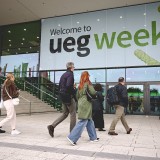
UEG Week is the largest and most prestigious gastroenterology meeting in Europe and has developed into a global congress. It attracts over 14,000 participants each year, from more than 120 countries, and numbers are steadily rising.

UEG Week provides a forum for basic and clinical scientists from across the globe to present their latest research in digestive and liver diseases, and also features a two-day postgraduate course that brings together top lecturers in their fields for a weekend of interactive learning.

Notes to Editors

*The ‘super-donor’ was an athletic Caucasian male aged 36 years. He was a healthy, non-smoker, with a normal BMI, who trained five times per week. He had been born via vaginal delivery and breast fed; he was not taking any regular medications, had only received three courses of antibiotics during his lifetime, and regularly took dietary supplements rich in proteins, vitamins, fibre, and minerals. 

For further information, or to arrange an interview with Professor Magdy El-Salhy, please contact Luke Paskins on +44 (0)1444 811099 or +44 (0) 7732 499170 or by email 

We kindly ask that a reference to UEG Week 2019 is included when communicating any information within this press release.

About Professor Magdy El-Salhy

Professor Magdy El-Salhy is a Professor of Gastroenterology and Hepatology at Bergen University, and consultant gastroenterologist at Stord Hospital, Norway 

References
  1. El-Salhy M, Haltebakk JG, Gilja OH, et al. Effects of faecal microbiota transplantation in patients with irritable bowel syndrome (IBS): a randomised, double-blind placebo-controlled study. Presented at UEG Week October 21, 2019.
  2. Enck P, Mazurak N. Dysbiosis in functional bowel disorders. Ann Nutr Metab. 2018;72(4):296-306.
  3. Johnsen PH, Hilpusch F, Cavanagh JP, et al. Faecal microbiota transplantation versus placebo for moderate-to-severe irritable bowel syndrome: a double-blind, randomised, placebo-controlled, parallel-group, single-centre trial. Lancet Gastroenterol Hepatol. 2018;3(1): 17-24.
  4.  Halkjaer SI, Christensen AH, Lo BZS, et al. Faecal microbiota transplantation alters gut microbiota in patients with irritable bowel syndrome: results from a randomised, double-blind placebo-controlled study. Gut. 2018;67(12):2107-15.
 

Comment

Please log in with your myUEG account to post comments.

Related Articles
Press Release
Artificially sweetened and sugary drinks are both associated with an increased risk of liver disease, study finds
Press Release
Microplastics found to change gut microbiome in first human-sample study
Press Release
Alcohol Labelling: Why Are Citizens Denied the Right to Know?
Press Release
Novel procedure combined with semaglutide may eliminate insulin dependency in type 2 diabetes
Latest Articles
Press Release
Europe must embed patient voices to transform digestive health outcomes, urges new UEG manifesto
Press Release
Europe faces rising liver cancer epidemic without urgent prevention and early detection measures
Press Release
Turning the Tide on Obesity and Digestive Health: Europe Must Act
Press Release
A call for comprehensive colorectal cancer screening
Get our newsletter!
Sign up with your email to receive UEG news and updates. We respect your privacy.

Headquarters Management

United European Gastroenterology

Wickenburggasse 1
1080 Vienna, Austria


T: +43 1 997 1639

UEG Week Registration

Mondial Congress & Events

Official UEG Week Registration Partner
Operngasse 20b
1040 Vienna, Austria


T: +43 1 58804 - 0

More

Imprint

Terms & Conditions

Media Policies

Privacy Policy

Accessibility Statement

Change cookie-settings

Social Media

7 767 Followers

23 000 Followers

15 666 Followers

5 866 Followers

3 670 Subscribers

11 399 Subscribers

65 Subscribers

409 Subscribers

UEG copyright 2025. All rights reserved. Use of this website constitutes acceptance of the Privacy Policy and Terms & Conditions.