• Offer for Industry
  • Young GI
  • Patients
  • Press
  • Newsletter
  • Contact us
UEG Connect
Create myUEG account
  • About
    • To landing page
      • Who we are
      • Boards, Committees & Groups
      • Governance
      • Headquarters Management
      • History
      • What we do
      • Strategic Drivers
      • Year in Review
      • Our Members
      • Specialist Member Societies
      • National Member Societies
      • UEG Community
      • UEG Associates
      • UEG Connect
      • Women in GI
      • Young GIs
      • Researchers
      • Event Calendar
  • Week
    • To landing page
      • Congress Resources
      • UEG Week Recordings ↗
      • CME Accreditation
      • Future UEG Week
      • Programme
      • Postgraduate Teaching
      • Industry
      • Supporters
  • Education
    • To landing page
      • Gutflix - Learning Platform ↗
      • Online Courses ↗
      • Mistakes in... ↗
      • UEG Podcast ↗
      • Webinars ↗
      • Summer School
      • Masterclass
      • Gut Guide
      • Career Development
      • CME in Europe
      • Supporters
  • Research
    • To landing page
      • Horizon Europe Support
      • Start-up Grant
      • Research Projects
      • HoloSurge
      • Intercept
      • InfoGut COST Action
      • White Book 2
      • Main Results
      • Full Reports
      • Materials and Presentations
  • Quality of Care
    • To landing page
      • Search Guidelines ↗
      • Non-English Guidelines
      • How to Develop Guidelines ↗
      • Quality of Care Initiatives
      • Quality Indicators
  • Public Affairs
    • To landing page
      • News
      • Focus Areas
      • Advocacy Toolbox
      • Stakeholder Collaboration
      • Digestive Health Month
      • Position Papers
      • Advocacy Bulletin
      • #EUNewsline
      • MEP Digestive Health Group
  • Publications
    • To landing page
      • Congress Publications
      • Research Publications
      • Public Affairs Publications
      • Education Publications
      • UEG Publications
      • UEG Journal ↗
      • UEG Journal Podcast ↗
  • Opportunities
    • To landing page
      • Top Abstract Prizes
      • National Scholar Award
      • Travel Grants
      • International Scholarship Awards
      • Research Prize
      • Research Fellowship
      • Lifetime Achievement Award
      • Journal Best Paper Award
      • Activities Endorsement
      • Rising Star Awards
      • Clinical Visiting Fellowships
      • Open Positions
      • Talent Pool
  • Gutflix ↗
  • Offer for Industry
  • Young GI
  • Patients
  • Press
  • Newsletter
  • Contact us
Press Release

Europe faces rising liver cancer epidemic without urgent prevention and early detection measures

October 05, 2025

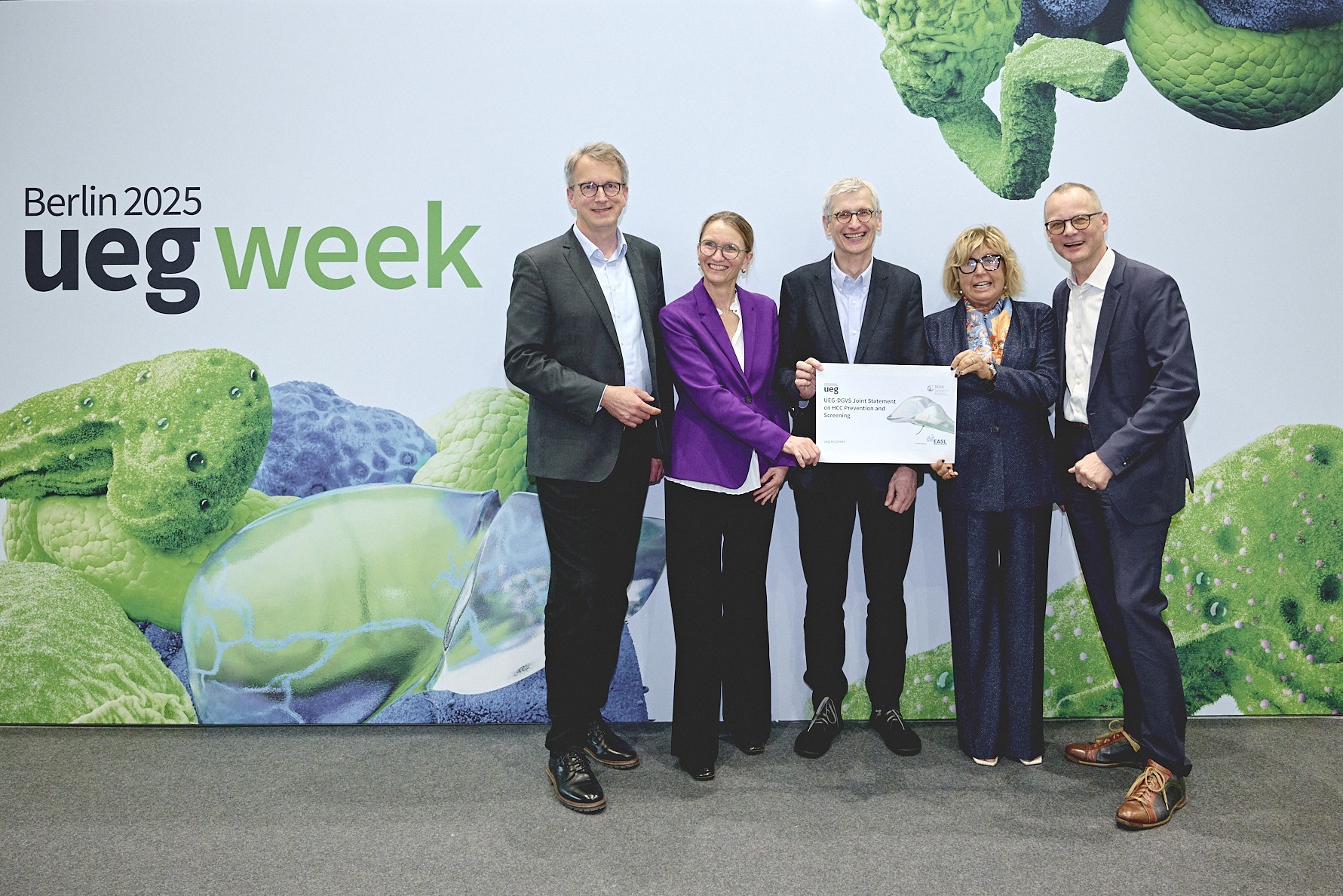
Liver cancer is among the fastest-growing causes of cancer death in Europe, with mortality expected to rise sharply over the next decade, recent research has shown.1 In response to this escalating crisis, United European Gastroenterology (UEG) and the German Society for Gastroenterology, Digestive and Metabolic Diseases (DGVS) have launched a joint statement on hepatocellular carcinoma (HCC) prevention and screening, unveiled today at UEG Week 2025 in Berlin.2

The liver cancer burden in Europe has increased significantly over the past three decades, with age-standardised incidence and mortality rates rising steadily between 1990 and 2021.1 It claimed more than 50,000 lives in the EU in 2022, with higher mortality in males than females.3 Hepatocellular carcinoma (HCC), the most common form of primary liver cancer, has driven much of this increase.4

Professor Patrizia Burra, Chair of the UEG Public Affairs Group, commented, “A unified, evidence-based strategy is essential to halting the rising toll of liver cancer in Europe. Addressing this urgent public health challenge requires a twofold approach, focusing on both prevention and early detection.”

Preventing HCC through nutrition and lifestyle is critical. Metabolic-associated steatotic liver disease (MASLD), driven by obesity, type 2 diabetes, and sedentary lifestyles, is a leading cause of HCC, while alcohol misuse and viral hepatitis B and C continue to fuel the burden despite available vaccines and treatments.5-7 Early diagnosis, testing and timely therapy are essential to reducing risk.2

“Prevention also begins with adequate nutrition,” added Professor Burra. “A Mediterranean-style diet, for example, reduces MASLD risk, whereas high consumption of ultra-processed foods increases liver cancer risk. But prevention must go beyond individual choices, and public health measures are essential, including improved food labelling, limits on marketing unhealthy foods to children, early nutrition education and stronger investment in both public health and physician training.”

While prevention tackles the root causes of liver disease, early detection is equally crucial, as timely diagnosis can dramatically improve outcomes.2 Early-stage HCC is often asymptomatic but curable if detected in time, yet most cases are diagnosed too late due to underdiagnosis of liver disease and unequal access to imaging.2

UEG and DGVS support targeted, risk-stratified surveillance, focusing monitoring on patients at highest risk while reducing unnecessary tests for low-risk individuals. For very high-risk groups, advanced biochemical tests, imaging and ideally genetic testing can improve early detection, enabling curative treatment and better long-term outcomes.2

Evidence across Europe shows that this approach increases early detection rates, improves survival and is cost-effective for healthcare systems.8

“Catching liver cancer early saves lives,” noted Professor Birgit Terjung, DGVS Board Member. “Risk-based surveillance focuses resources on those most likely to develop HCC, improving outcomes while avoiding unnecessary tests for low-risk patients.”

Building on prevention and early detection, the joint UEG and DGVS statement calls on policymakers to take immediate action to change the trajectory of liver cancer across Europe by:

  • Recognising liver cancer as a potentially preventable and increasingly prevalent public health priority.
  • Implementing and funding structured HCC surveillance programmes guided by risk thresholds.
  • Supporting public health initiatives aimed at reducing obesity, alcohol misuse and hepatitis transmission.
  • Expanding physician training in nutrition and hepatology.
  • Ensuring equitable access to screening tools, including radiological imaging, in high-risk cohorts.
  • Taxing obesogenic foods and reducing the tax burden on healthy foods (sugar/fat tax).
  • Promoting EU-wide nutrition labelling, such as Front-of-Pack Labelling systems like Nutri-Score.

Both societies concluded with a clear message that Europe cannot afford to ignore the ticking time bomb of liver cancer. The evidence, tools, and strategies are already available – what is now required is the political will to act.

“Success depends on coordinated action at every level,” added Professor Terjung. “From prevention and early detection to equitable access to care, governments, healthcare providers and the public all have a role to play if we are to turn the tide on liver cancer.”

Access the full statement here

Social Sharing
  • Notes to editors
  • References
Notes to editors

The joint statement was prepared by United European Gastroenterology (UEG) and the Deutsche Gesellschaft für Gastroenterologie, Verdauungs- und Stoffwechselkrankheiten (DGVS) with endorsement from the European Association for the Study of the Liver (EASL), on the occasion of UEG Week 2025 in Berlin.

For further information or to arrange an expert interview, please contact

We kindly ask that a reference to UEG and the DGVS is included when communicating any information within this press release.

About UEG:

Founded in 1992, United European Gastroenterology (UEG) is the leading non-profit organisation for excellence in digestive health in Europe and beyond with its headquarters in Vienna. We improve the prevention and care of digestive diseases in Europe through providing top tier education, supporting research and advancing clinical standards.

As Europe’s home and umbrella for multidisciplinary gastroenterology, we unite over 50,000 engaged professionals from national and specialist societies, individual digestive health experts and related scientists from all fields and career stages. Over 30,000 digestive healthcare professionals from around the world have joined the UEG Community as UEG Associates and UEG Young Associates. The UEG Community enables digestive health professionals from across the globe to become UEG Associates and thereby connect, network and benefit from a wide range of free resources and educational activities.

Find out more about UEG’s work by visiting: https://ueg.eu/

About the DGVS:

The German Society for Gastroenterology, Digestive and Metabolic Diseases (DGVS) was founded in 1913 as a scientific society for research into the digestive organs. Today, it unites over 7,000 doctors working in clinics and research under one roof. The DGVS very successfully promotes scientific projects and studies, organises congresses and training courses and actively supports young scientists. A particular concern of the DGVS is the development of standards and treatment guidelines for the diagnosis and treatment of diseases of the digestive organs - for the benefit of patients.

References

1. Kazi, Onika MDa; et al. Burden of liver cancer in the European region from 1990 to 2021: a sub-analysis of the global burden of disease study. Annals of Medicine & Surgery 87(7):p 4053-4065, July 2025.

2. UEG and DGVS joint statement on HCC prevention and screening. Published October 2025.

3. European Commission. (2025). Liver cancer prevention: Evidence and policy approaches. Knowledge4Policy Health Promotion Gateway.

4. European Commission. (2024). Liver cancer inequalities in Europe and the role of viral hepatitis. Luxembourg: Publications Office of the European Union.

5. Rinella, M. E., Neuschwander-Tetri, B. A., Siddiqui, M. S., Abdelmalek, M. F., Caldwell, S., Barb, D., Kleiner, D. E., & Loomba, R. (2023). AASLD Practice Guidance on the clinical assessment and management of nonalcoholic fatty liver disease. Hepatology (Baltimore, Md.), 77(5), 1797–1835.

6. World Health Organization. (2024). Preventing cancer. Geneva: WHO.

7. World Health Organization. (2024). WHO sounds the alarm on viral hepatitis infections; Chronic HBV and HCV still claim over 1.3 million lives annually.

8. European Association for the Study of the Liver (EASL). (2023). Risk-based surveillance for hepatocellular carcinoma among patients with cirrhosis: EASL policy statement.

Comment

Please log in with your myUEG account to post comments.

Latest Articles
Press Release
Europe must embed patient voices to transform digestive health outcomes, urges new UEG manifesto
Press Release
Microplastics found to change gut microbiome in first human-sample study
Press Release
Artificially sweetened and sugary drinks are both associated with an increased risk of liver disease, study finds
Press Release
Turning the Tide on Obesity and Digestive Health: Europe Must Act
Get our newsletter!
Sign up with your email to receive UEG news and updates. We respect your privacy.

Headquarters Management

United European Gastroenterology

Wickenburggasse 1
1080 Vienna, Austria


T: +43 1 997 1639

UEG Week Registration

Mondial Congress & Events

Official UEG Week Registration Partner
Operngasse 20b
1040 Vienna, Austria


T: +43 1 58804 - 0

More

Imprint

Terms & Conditions

Media Policies

Privacy Policy

Change cookie-settings

Social Media

7 767 Followers

23 000 Followers

15 666 Followers

5 866 Followers

3 670 Subscribers

11 399 Subscribers

65 Subscribers

409 Subscribers

UEG copyright 2025. All rights reserved. Use of this website constitutes acceptance of the Privacy Policy and Terms & Conditions.