• Offer for Industry
  • Young GI
  • Patients
  • Press
  • Newsletter
  • Contact us
UEG Connect
Create myUEG account
  • About
    • To landing page
      • Who we are
      • Boards, Committees & Groups
      • Governance
      • Headquarters Management
      • History
      • What we do
      • Strategic Drivers
      • Year in Review
      • Our Members
      • Specialist Member Societies
      • National Member Societies
      • UEG Community
      • UEG Associates
      • UEG Connect
      • Women in GI
      • Young GIs
      • Researchers
      • Event Calendar
  • Week
    • To landing page
      • Congress Resources
      • UEG Week Recordings ↗
      • CME Accreditation
      • Future UEG Week
      • Programme
      • Postgraduate Teaching
      • Industry
      • Supporters
  • Education
    • To landing page
      • Gutflix - Learning Platform ↗
      • Online Courses ↗
      • Mistakes in... ↗
      • UEG Podcast ↗
      • Webinars ↗
      • Summer School
      • Masterclass
      • Gut Guide
      • Career Development
      • CME in Europe
      • Supporters
  • Research
    • To landing page
      • Horizon Europe Support
      • Start-up Grant
      • Research Projects
      • HoloSurge
      • Intercept
      • InfoGut COST Action
      • White Book 2
      • Main Results
      • Full Reports
      • Materials and Presentations
  • Quality of Care
    • To landing page
      • Search Guidelines ↗
      • Non-English Guidelines
      • How to Develop Guidelines ↗
      • Quality of Care Initiatives
      • Quality Indicators
  • Public Affairs
    • To landing page
      • News
      • Focus Areas
      • Advocacy Toolbox
      • Stakeholder Collaboration
      • Digestive Health Month
      • Position Papers
      • Advocacy Bulletin
      • #EUNewsline
      • MEP Digestive Health Group
  • Publications
    • To landing page
      • Congress Publications
      • Research Publications
      • Public Affairs Publications
      • Education Publications
      • UEG Publications
      • UEG Journal ↗
      • UEG Journal Podcast ↗
  • Opportunities
    • To landing page
      • Top Abstract Prizes
      • National Scholar Award
      • Travel Grants
      • International Scholarship Awards
      • Research Prize
      • Research Fellowship
      • Lifetime Achievement Award
      • Journal Best Paper Award
      • Activities Endorsement
      • Rising Star Awards
      • Clinical Visiting Fellowships
      • Open Positions
      • Talent Pool
  • Gutflix ↗
  • Offer for Industry
  • Young GI
  • Patients
  • Press
  • Newsletter
  • Contact us
Press Release

Family doctor intervention is crucial in the fight against Europe’s second biggest cancer killer

April 25, 2014

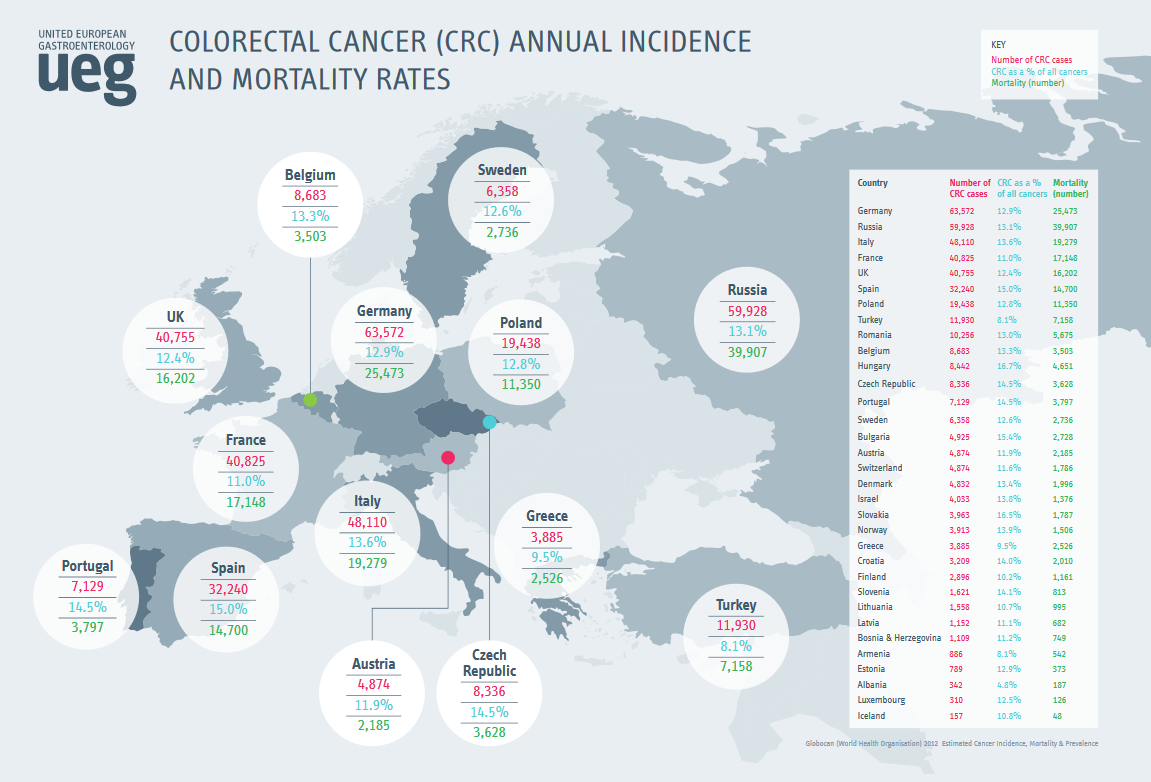
As healthcare professionals, commissioners and politicians from across Europe convened earlier this month for the third ‘European Colorectal Cancer Days’ meeting in Brno in the Czech Republic, one of the meeting’s supporters, United European Gastroenterology (UEG) is calling for increased intervention from primary care physicians to improve colorectal cancer (CRC) screening uptake rates across Europe.

CRC is currently estimated to claim the lives of 214,6751 adults in Europe – equivalent to 1 death every 3 minutes – and is expected to affect 502,000 Europeans a year by 20202. 

CRC screening programmes are currently underused with the uptake throughout much of Europe falling way short of the 65% rate considered desirable by the European Commission.

With the annual incidence of Europe’s second most lethal cancer killer predicted to rise by 12% by 20202 UEG is raising awareness that screening saves lives and believes that family doctor intervention is key to preventing rising mortality.

“Family doctors play a crucial role in the prevention and early detection of colorectal cancer by raising the subject of screening with eligible adults and explaining the benefits of available screening options,” explains UEG President Professor Michael Farthing.

“Research has found that lack of recommendation by a family doctor is a key barrier to colorectal cancer screening uptake. By proactively broaching the subject of screening, general practitioners can overcome common fears and misconceptions as well as the embarrassment factor that so often prevents people talking about and participating in CRC screening.”

Colorectal cancer is extremely lethal in its advanced stages yet early detection can result in a 90-95% survival rate. Regular screening reduces the risk of dying from the disease by 20-30% using the Faecal Occult Blood Test (FOBT), 50% using flexible sigmoidoscopy and up to 65% using colonoscopy. Widely available across Europe, the FOBT is generally offered to men and women over the age of 50 via an invitation from their doctor or a national screening programme.

The involvement of family doctors in CRC screening in Europe varies. In some countries (Germany, France, the Czech Republic), family doctors actually perform FOB testing in their surgeries; in others, they are tasked with recruiting patients for colonoscopic screening (Poland); while in countries such as the UK and the Netherlands, family doctors are not directly involved in screening but instead are required to encourage patients to participate in national programmes and to advise on the importance of screening.

" It is very important in countries with active screening programmes in place that comprehensive colorectal cancer education and support for family doctors is available to help them put screening high on the agenda at a practice level. Motivated and well informed doctors will in turn mobilise patients, and the link between patient screening compliance and practitioner motivation is well documented,” explains Professor Farthing.

#screeningsaveslives

Which patient groups do/don’t participate in CRC screening?

  • Research has found a higher participation rate of women in FOBT-based screening programmes across Europe than in men.3
  • Age is also a factor. Italian research found that men and women aged 65 years or older were more likely to participate in screening than younger invitees.4
  • Smokers have been found to have poor CRC screening adherence compared to non-smokers and former smokers.5
  • Adherence to other screening programmes e.g. prostate cancer (men) and breast cancer (women) has been positively associated with CRC screening uptake.6
  • Research in Spain found that fear of screening tests and embarrassment were the main barriers that contributed to low participation.7
Social Sharing
  • About UEG
  • About UEG Week
  • References
About UEG

UEG, or United European Gastroenterology, is a professional non-profit organisation combining all the leading European medical specialist and national societies focusing on digestive health.

Our member societies represent more than 30,000 specialists from every field of gastroenterology. Together, we provide services for all healthcare professionals and researchers, in the broad area of digestive health. The role of UEG is to take concerted efforts to learn more about digestive disease by prevention, research, diagnosis, cure and raising awareness of their importance. 

To advance the standards of gastroenterological care and knowledge across the world and to reduce the burden of digestive diseases, UEG offers numerous activities and initiatives, including:

  • UEG Week: Organising the best international multidisciplinary gastroenterology congress in the world
  • UEG Research: Supporting cooperation and excellence in digestive health research
  • UEG Journal: Delivering clinical information for digestive health with authority
  • UEG Education: Providing learning oportunities in multiple formats
  • Quality of Care: Improving clinical practice to reduce health inequalities across Europe
  • Public Affairs: Acting as the united voice of European Gastroenterology towards the public and policy makers

Find out more about UEG’s work by visiting www.ueg.eu or contact:    

Luke Paskins on +44 (0)1444 811099 or  
About UEG Week

UEG Week is the largest and most prestigious gastroenterology meeting in Europe and has developed into a global congress. It attracts over 14,000 participants each year, from more than 120 countries, and numbers are steadily rising.

UEG Week provides a forum for basic and clinical scientists from across the globe to present their latest research in digestive and liver diseases, and also features a two-day postgraduate course that brings together top lecturers in their fields for a weekend of interactive learning.

References
  1. Globocan Estimated Cancer Incidence, Mortality and Prevalence, 2012
  2. International Agency for Research on Cancer (IARC)
  3. M.Von Euler-Cheplin, K.Brasso and E.Lynge, "Determinants of Participation in CRC screening with faecal occult blood testing," Journal of Public Health
  4. N.Segnan, C. Senore, B. Andreoni et al, "Randomized trial of different screening strategies for colorectal cancer: patient response and detection rates," Journal of the National Cancer Institute
  5. G.N. Ioannou, M. K. Chapko and J. A. Dominitz, "Predictors of CRC screening participation in the USA," American Journal of Gastroenterology
  6. R. C. Carlos, A. M. Fendrick, J. Ellis and S. J. Bernstein, "Can breast and cervical cancer screening visits be used to enhance colorectal cancer screening?" Journal of American College of Radiology [7] A. Z. Gimeno-Garcia, E Quintero, D Nicolas Perez, A Parra-Blanco and A. Jimenez-Sosa, "Impact of an educational video-based strategy on the behaviour process associated with colorectal cancer screening: a randomized controlled study", Cancer Epidemiology

Comment

Please log in with your myUEG account to post comments.

Related Articles
Press Release
Europe faces rising liver cancer epidemic without urgent prevention and early detection measures
Press Release
Turning the Tide on Obesity and Digestive Health: Europe Must Act
Press Release
Alcohol Labelling: Why Are Citizens Denied the Right to Know?
Press Release
A call for comprehensive colorectal cancer screening
Latest Articles
Press Release
Europe must embed patient voices to transform digestive health outcomes, urges new UEG manifesto
Press Release
Microplastics found to change gut microbiome in first human-sample study
Press Release
Artificially sweetened and sugary drinks are both associated with an increased risk of liver disease, study finds
Press Release
Innovative nanoparticle therapy targets fat absorption to combat obesity
Get our newsletter!
Sign up with your email to receive UEG news and updates. We respect your privacy.

Headquarters Management

United European Gastroenterology

Wickenburggasse 1
1080 Vienna, Austria


T: +43 1 997 1639

UEG Week Registration

Mondial Congress & Events

Official UEG Week Registration Partner
Operngasse 20b
1040 Vienna, Austria


T: +43 1 58804 - 0

More

Imprint

Terms & Conditions

Media Policies

Privacy Policy

Change cookie-settings

Social Media

7 767 Followers

23 000 Followers

15 666 Followers

5 866 Followers

3 670 Subscribers

11 399 Subscribers

65 Subscribers

409 Subscribers

UEG copyright 2025. All rights reserved. Use of this website constitutes acceptance of the Privacy Policy and Terms & Conditions.