• Offer for Industry
  • Young GI
  • Patients
  • Press
  • Newsletter
  • Contact us
UEG Connect
Create myUEG account
  • About
    • To landing page
      • Who we are
      • Boards, Committees & Groups
      • Governance
      • Headquarters Management
      • History
      • What we do
      • Strategic Drivers
      • Year in Review
      • Our Members
      • Specialist Member Societies
      • National Member Societies
      • UEG Community
      • UEG Associates
      • UEG Connect
      • Women in GI
      • Young GIs
      • Researchers
      • Event Calendar
  • Week
    • To landing page
      • Congress Resources
      • UEG Week Recordings ↗
      • CME Accreditation
      • Future UEG Week
      • Programme
      • Postgraduate Teaching
      • Industry
      • Supporters
  • Education
    • To landing page
      • Gutflix - Learning Platform ↗
      • Online Courses ↗
      • Mistakes in... ↗
      • UEG Podcast ↗
      • Webinars ↗
      • Summer School
      • Masterclass
      • Gut Guide
      • Career Development
      • CME in Europe
      • Supporters
  • Research
    • To landing page
      • Horizon Europe Support
      • Start-up Grant
      • Research Projects
      • HoloSurge
      • Intercept
      • InfoGut COST Action
      • White Book 2
      • Main Results
      • Full Reports
      • Materials and Presentations
  • Quality of Care
    • To landing page
      • Search Guidelines ↗
      • Non-English Guidelines
      • How to Develop Guidelines ↗
      • Quality of Care Initiatives
      • Quality Indicators
  • Public Affairs
    • To landing page
      • News
      • Focus Areas
      • Advocacy Toolbox
      • Stakeholder Collaboration
      • Digestive Health Month
      • Position Papers
      • Advocacy Bulletin
      • #EUNewsline
      • MEP Digestive Health Group
  • Publications
    • To landing page
      • Congress Publications
      • Research Publications
      • Public Affairs Publications
      • Education Publications
      • UEG Publications
      • UEG Journal ↗
      • UEG Journal Podcast ↗
  • Opportunities
    • To landing page
      • Top Abstract Prizes
      • National Scholar Award
      • Travel Grants
      • International Scholarship Awards
      • Research Prize
      • Research Fellowship
      • Lifetime Achievement Award
      • Journal Best Paper Award
      • Activities Endorsement
      • Rising Star Awards
      • Clinical Visiting Fellowships
      • Open Positions
      • Talent Pool
  • Gutflix ↗
  • Offer for Industry
  • Young GI
  • Patients
  • Press
  • Newsletter
  • Contact us
Decide on the Spot

A coeliac conundrum

October 27, 2015 | Ruchit Sood

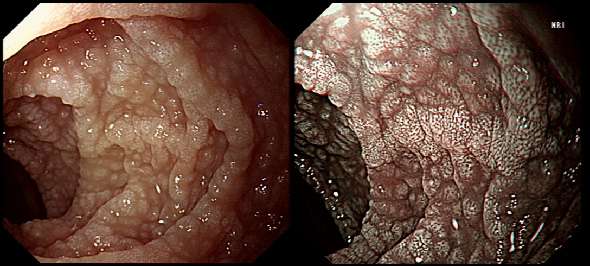
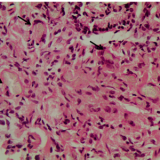
A middle-aged woman presented with loose stool and weight loss. Initially, she refused an endoscopy and a diagnosis of coeliac disease was made on the basis of a high tissue transglutaminase (tTG) antibody titre. She was started on a gluten-free diet (GFD) but her symptoms remained despite adherence to the GFD. After several months she agreed to undergo an endoscopy. The images show the endoscopic view of the duodenal mucosa (figure 1) and the corresponding histology slide (figure 2) stained with haemotoxylin and eosin (H&E).

Figure 1 | The endoscopic view of the duodenal mucosa of the case patient, visualised by both white-light and narrow-band imaging.

Case Question 1

What would you do next?

a) Refer the patient for a dietary review

b) Request a clonal analysis of the intraepithelial lymphocytes

c) Refer for HLA DQ2/DQ8 testing

d) Refer the patient for capsule endoscopy

e) Add prednisolone to the dietary restrictions

  • Case question 1 answer and discussion
Case question 1 answer and discussion

Correct answer: e.

Discussion

Initially, the patient appeared to have classic coeliac disease, with diarrhoea and weight loss together with a positive serology. The endoscopy was crucial as the duodenal biopsies identified the presence of a thick band-like deposit of collagen just below the duodenal epithelium. On the basis of this finding, collagenous sprue was diagnosed.

Collagenous sprue was first described in 1947,1 but it was not until 1970 that Weinstein et al. introduced it as a diagnostic term to the medical nomenclature.2 Collagenous sprue is more frequent in females and in individuals who have other autoimmune diseases.3 It is now recognised that collagenous sprue shares similar clinical features with coeliac disease, such as chronic diarrhoea, anaemia and weight loss. In addition, the endoscopic and histological features of both diseases are similar, with an atrophic and scalloped duodenal mucosa. However, the histological hallmark of collagenous sprue is the presence of a thick subepithelial collagen band. Such collagen bands may also be found in collagenous gastritis and collagenous colitis.4

It has been proposed that collagenous sprue may be a heterogenous condition of collagenous gastroenteritides, including conditions such as collagenous colitis and coeliac disease.5,6 Unlike coeliac disease, in collagenous sprue, the typical histological changes may also be found in the stomach and colon.7 Furthermore, greater numbers of IgG4 plasma cells have been reported in the duodenal mucosa of patients with collagenous sprue when compared with the numbers in patients with coeliac disease, duodenitis or normal duodenal mucosa.8

As in this case, patients with collagenous colitis usually also have positive coeliac serology. For this reason, some believe that the collagen band is simply a marker of particularly severe coeliac disease, which may also be associated with ulceration, perforation and T-cell or B-cell lymphoma.9

An interesting report of paraneoplastic collagenous colitis was reported by Freeman et.al.10 In that case a patient with collagen deposits in both the small and large intestine was also found to have a coincidental colon cancer. After surgery, both the malabsorption and the histopathological changes completely resolved! For this reason, a search for underlying malignant disease should be considered.

The response to a GFD is usually disappointing, and for this reason the outlook used to be grave for patients with collagenous sprue. However, remission of the condition has been reported with courses of corticosteroids11 or immunosuppressive agents such as infliximab.12
References

  1. Schein J. Syndrome on non tropical sprue with hitherto undescribed lesions of the intestine. Gastroenterology 1947; 8: 438–460.
  2. Weinstein WM, Saunders DR, Tytgat GN, et al. Collagenous sprue—an unrecognized type of malabsorption. N Engl J Med 1970; 283: 1297–1301. http://www.nejm.org/doi/full/10.1056/NEJM197012102832401
  3. Rubio-Tapia A, Talley NJ, Gurudu SR, et al. Gluten-free diet and steroid treatment are effective therapy for most patients with collagenous sprue. Clin Gastroenterol Hepatol 2010; 8: 344–349.e3. http://www.cghjournal.org/article/S1542-3565(09)01332-9/abstract
  4. Zhao X and Johnson RL. Collagenous sprue: a rare, severe small-bowel malabsorptive disorder. Arch Pathol Lab Med 2011; 135: 803–809. http://www.archivesofpathology.org/doi/abs/10.1043/2010-0028-RS.1
  5. Maguire AA, Greenson JK, Lauwers GY, et al. Collagenous sprue. A clinicopathologic study of 12 cases. Am J Surg Pathol 2009; 33: 1440–1449. http://journals.lww.com/ajsp/Abstract/2009/10000/Collagenous_Sprue__A_Clinicopathologic_Study_of_12.2.aspx
  6. Nielsen OH, Riis LB, Danese S, et al. Proximal collagenous gastroenteritides: Clinical management. A systematic review. Ann Med 2014; 46: 311–317. http://www.tandfonline.com/doi/full/10.3109/07853890.2014.899102
  7. Robert ME, Ament ME and Weinstein WM. The histologic spectrum and clinical outcome of refractory and unclassified sprue. Am J Surg Pathol 2000; 24: 676–687. http://journals.lww.com/ajsp/Abstract/2000/05000/The_Histologic_Spectrum_and_Clinical_Outcome_of.6.aspx
  8. Schoolmeester JK, Jenkins SM, Murray JA, et al. Increased immunoglobulin G4-positive plasma cells in collagenous sprue. Hum Pathol 2013; 44: 1624–1629. http://www.humanpathol.com/article/S0046-8177(13)00046-4/abstract
  9. Freeman HJ. Collagenous sprue associated with an extensive T-cell lymphoma. J Clin Gastroenterol 2003; 36(2): 144–146. http://journals.lww.com/jcge/Abstract/2003/02000/Collagenous_Sprue_Associated_with_an_Extensive.11.aspx
  10. Freeman HJ and Berean KW. Resolution of paraneoplastic collagenous enterocolitis after resection of colon cancer. Can J Gastroenterol Hepatol 2006; 20: 357–360. http://www.pulsus.com/journals/abstract.jsp?sCurrPg=journal&jnlKy=2&atlKy=913&isuKy=268&isArt=t
  11. Freeman HJ, Davis JE and Myers DM. Complete histologic resolution of collagenous sprue. Can J Gastroenterol Hepatol 2004; 18: 333–336. http://www.pulsus.com/journals/abstract.jsp?sCurrPg=journal&jnlKy=2&atlKy=3473&isuKy=244&isArt=t
  12. Schmidt C, Kasim E, Schlake W, et al. TNF- antibody treatment in refractory collagenous sprue: Report of a case and review of the literature. Z Gastroenterol 2009; 47: 575–578. https://www.thieme-connect.de/products/ejournals/abstract/10.1055/s-0028-1109057
Social Sharing
  • About the Author
About the Author

Ruchit Sood is an advanced endoscopy fellow at Leeds Teaching Hospitals, UK. He graduated from the University of Sheffield in 2005 and commenced his postgraduate training in gastroenterology in 2009. He is in the process of completing a Doctorate of Medicine from the University of Leeds, and to date he has published over 20 peer-reviewed articles. His main interest is in advanced therapeutic endoscopy, in particular upper and lower gastrointestinal tract endoscopic mucosal resection.

Comment

Please log in with your myUEG account to post comments.

Latest Articles
Decide on the Spot
An elusive lesion in the colon
Decide on the Spot
A rare biopsy finding with many possible causes
Decide on the Spot
An incidental diagnosis by endoscopic ultrasound
Decide on the Spot
A not-so-black-and-white case of gastrointestinal bleeding
Get our newsletter!
Sign up with your email to receive UEG news and updates. We respect your privacy.

Headquarters Management

United European Gastroenterology

Wickenburggasse 1
1080 Vienna, Austria


T: +43 1 997 1639

UEG Week Registration

Mondial Congress & Events

Official UEG Week Registration Partner
Operngasse 20b
1040 Vienna, Austria


T: +43 1 58804 - 0

More

Imprint

Terms & Conditions

Media Policies

Privacy Policy

Change cookie-settings

Social Media

7 767 Followers

23 000 Followers

15 666 Followers

5 866 Followers

3 670 Subscribers

11 399 Subscribers

65 Subscribers

409 Subscribers

UEG copyright 2025. All rights reserved. Use of this website constitutes acceptance of the Privacy Policy and Terms & Conditions.